Plans for the next installment of “In Sondry Ages and Sondry Londes” are now in place. Organized by Sophia Yashih Liu (National Taiwan University), Yu-Ching (Louis) Wu (National Central University), and Jonathan Fruoco (University Paris Nanterre [CREA]), the conference will be held at National Taiwan University in Tapei and will honor Dr. Francis K. H. So, whose Mandarin Chinese translation of The Canterbury Tales was published in 2025.
I’ll be there, and I hope to see many of you there, too.
In Sondry Ages and Sondry Londes] Reading Chaucer outside the Anglophone World: Receptions, Translations, and Traditions Date: March 12–13, 2027 Venue: National Taiwan University, Taiwan **
The recent Mandarin Chinese translation of The Canterbury Tales (Linking Publishing, 2025) by Dr. Francis K. H. So offers a timely opportunity to reflect on the growing presence, vitality, and diversity of Chaucerian studies outside the Anglophone world. This significant contribution not only opens new avenues for engaging with Geoffrey Chaucer’s language and narrative art, but also foregrounds the crucial role of translation, pedagogy, and local scholarly traditions in shaping how Chaucer is read, interpreted, and taught across different linguistic and cultural contexts.
Aligned with the New Chaucer Society’s (NCS) ongoing initiative “In Sondry Ages and Sondry Londes” (curated by Dr. Jonathan Fruoco), this international conference seeks to advance a more globally grounded Chaucerian studies, one that situates the significance of Chaucer beyond the Anglophone world by foregrounding translation, adaptations, multilingual readerships, pedagogical practices, and cross-cultural intellectual exchange. By bringing together scholars working across diverse linguistic regions and by creating a venue for established scholars, early-career researchers, and graduate students, the conference aims to foster sustained conversations about Chaucer’s afterlives and to strengthen transnational scholarly networks shaped by translation, adaptation, and comparative inquiry.
The keynote speakers are Dr. Candace Barrington, Professor of English at Central Connecticut State University and President of the New Chaucer Society, whose work focuses on Chaucer and medieval English literature, especially global reception, translation, and adaptation, and Dr. Francis K. H. So, Professor Emeritus at National Sun Yat-sen University, whose scholarship centers on Chaucer, medieval and Renaissance English literature, East–West comparative studies, and the translation and global circulation of premodern texts.
We invite proposals that explore any aspect of Chaucer’s works, their translations and adaptations, as well as their critical or creative receptions outside the Anglophone world, or in comparative and transregional contexts. Possible topics include (but are not limited to):
Translation, Adaptation, and Literary Mediation
New approaches to, or challenges in, translating Chaucer into non-Anglophone languages
Histories of major translations and translators, and the role of translation in shaping local understandings of Chaucer
Considerations of the role publishers (both university and commercial presses) supporting and promoting editions of Chaucer outside the Anglophone sphere
Theoretical reflections on translation, vernacularity, and Middle English in multilingual or cross-cultural contexts
Chaucer-inspired works in contemporary literature, media, or visual culture
Reception, Pedagogy, and Intellectual Histories
Histories of Chaucerian scholarship in non-Anglophone academic traditions
Pedagogical practices and challenges in teaching Chaucer in multilingual or non-Anglophone classrooms
Chaucer in textbook cultures, anthologies, curricula, and the formation of literary canons, particularly the “World Literature” category Chaucer in Global and Comparative Perspectives
Cross-cultural approaches to medieval narrative, performance, humor, or religiosity
Comparative medievalisms across linguistic, national, or cultural traditions
Reading Chaucer alongside non-Western or premodern texts (for example, The Tale of Genji, The Cloud Dream of the Nine, and Romance of the Three Kingdoms), with attention to narrative framing, irony, or social satire
Intersections between Chaucer and local philosophical or aesthetic traditions
Texts, Traditions, and Critical Methods
Critical innovations on Chaucer’s oeuvre (The Canterbury Tales, Troilus and Criseyde, the dream visions, Chaucer’s translations of Latin and French texts, and shorter poems), through lenses such as gender, race, affect, ecology, embodiment, or disability
Manuscript studies, material culture, digital humanities, or archival research, particularly Middle English manuscripts housed in Asia and the global South.
Chaucer, colonialism, and postcolonial reception histories in non-Anglophone contexts
The conference will be held in person on March 12–13, 2027, at National Taiwan University, Taipei, Taiwan. Please submit a proposal (250 words in English) along with a brief bio of 100 words to readingchaucer@gmail.com by June 30, 2026. In addition to individual paper proposals, the conference welcomes panel proposals consisting of three to four papers organized around a shared theme. Panel submissions should include a panel abstract (300 words) outlining the panel’s coherence and relevance to the conference theme, along with individual paper abstracts (250 words each) and a brief 100-word bio for each participant.
We particularly welcome submissions from graduate students and early-career scholars, and we hope this gathering will reinforce and expand long-term networks of Chaucerian research beyond the Anglophone world. There is no registration fee for the conference. For updated information, please visit the conference website: https://readingchaucer.com/.
This event is co-sponsored by the New Chaucer Society (NCS), the Taiwan Association of Classical, Medieval, and Renaissance Studies (TACMRS), University Paris Nanterre (CREA), and the National Science and Technology Council (NSTC), Taiwan.
Conference Organizers: Sophia Yashih Liu, National Taiwan University Yu-Ching (Louis) Wu, National Central University Jonathan Fruoco, University Paris Nanterre (CREA)
Much of the history of the Global Chaucers project could be written be detailing a series of chance encounters and missed opportunities. One of the more recent examples of a chance encounter was my meeting Danko Kamčevski (Metropolitan University of Belgrade) this past November at the Chaucer in the Age of Medievalism conference at the University of Lorraine (Nancy, France). He not only knew about Boris Hlebec’s 1983 Serbian translation–Džefri Čoser’s Kanterberijske priče–but offered to send me a copy. Indeed, just a few days after the conference, he wrote that he’d found a copy and gone to the post office to mail it, only to be informed that, in response to the ongoing tariffs, the Serbian Post Office does not allow packages to be sent to the United States.
Meanwhile, Danko has shared a careful explication of Hlebec’s translation of a passage from The Knight’s Tale as well as forwarded Sergej Macura’s 2025 article examining the metrical and lexical equivalences between Chaucer’s Middle English General Prologue and Hlebec’s translation. He has also notified me that Professor Hlebec has recently died. Never getting to correspond with Chaucer’s Serbian translator is my missed opportunity.
Eventually, I’ll find a way to get Kanterberijske priče, and both Danko Kamčevski’s explication and Sergej Macura’s article will contribute significantly to my current writing project. I do wish, though, that I could have thanked Professor Hlebec for his contributions.
The 2026 NCS Congress Program Committee warmly invites additional proposals for the Congress’s Research Expo. The Research Expo will host research with strong visual or digital elements presented in a display or poster format. Presenters will discuss their display and the underpinning research during a single launch session.
This session is open to a range of formats and topics that may offer updates on work-in-progress, preliminary conclusions, experimental modes of presenting research data, and shorter summaries of material. Topics particularly suited to posters might include, but are certainly not limited to:
Research on manuscripts or other aspects of material culture
Image-heavy work that deploys visual analysis
Updates on large-scale funded projects or other grant funded work-in-progress
Data-driven work that is communicated in graphical forms
Experimental digital methods
Incorporate a hands-on or other interactive element
Posters will be displayed in a hall where receptions will be held and a time will be reserved for researchers to talk about their work. A prize will be offered to one poster.
Note: The printing of posters can be done in Freiburg (and at no cost) before the conference (more information will be provided to those whose posters are accepted).
To submit a proposal: Proposals should be titled and no longer than 200 words. Please include your name, affiliation, and your email address along with your abstract. Please email your proposal directly to the Research Expo organisers Mary Flannery, R. D. Perry, and J. R. Mattison at ncs2026freiburg@gmail.comno later than 31 December 2025.
One of the great joys of the Global Chaucers project has been the opportunity to correspond (and sometimes meet) many translators and scholars from around the world. Each one has taught me much about translation, Chaucer, and the joys of literature. Perhaps none taught me more than John Boje of Pretoria, South Africa.
He and I began corresponding in November 2013. I had learned (from someone on some platform) about his ‘n Keur uit die Pelgrimsverhale van Geoffrey Chaucer [A Selection of the Pilgrims’ Tales of Geoffrey Chaucer]. I emailed him, asking if he’d be willing to answer some questions. I tapped “send,” and before I had a chance to make a cup of tea, I heard back from him with an enthusiastic “Yes!” And so began our collaboration and our friendship.
Earlier that year, he had completed his translation of all the tales (including, he was proud to report, The Parson’s Tale and The Tale of Melibee), so all the tribulations and victories of translation were fresh in his mind. I would send one-line questions, and he’d respond with pages filled with exuberant answers and multiple examples. He described complications and shared insights that I didn’t have the experience to imagine. He gleefully (and mischievously) explained how he exploited the common Dutch ancestry of both Middle English and Afrikaans words. He showed me how Afrikaans, a language associated with an oppressive regime, could be slyly used (in ways that Chaucerians can appreciate) to subvert the dominant discourse.
I am fortunate that I learned of his decline in time to send him a note expressing my gratitude. I wanted him to know that our initial email conversations became the foundation of my scholarly practice. His clear and enthusiastic answers to my ambitious questions convinced me that I would be able to make a long-term project out of my germ of an idea.
I must add one more note: John’s generosity of spirit extended far beyond the gracious help he offered me. As his friends and family testify, he provides an unbeatable example of how to work towards a world where “justice can rise up / And hope and history rhyme” (Seamus Heaney, “The Cure of Troy”).
Colloquium organizers–Justine Breton and Jonathan Fruoco–have announced the full program for the upcoming Chaucer in the Age of Medievalism to be held at the University of Lorraine in Nancy, France, 13-14 November 2025.
Any attending the conference will not need to register or pay a fee. There will not be an online option.
Next month’s event is part of Jonathan Fruoco’s “In Sondry Ages and Sundry Londes” conference cycle sponsored by the New Chaucer Society. These events explore Chaucer’s presence and reception in non-Anglophone countries. Prior conferences took place in Grenoble, France (2018) and Hiroshima, Japan (2023). Jonathan is looking for someone to help organize the next conference outside of the Anglosphere in 2027. Contact him at jonathan dot fruoco at gmail dot com if you’re interested.
Compiler’s note: The annotated list shared here is the result of serious sleuthing through archives, libraries, and used bookstores, but it is by no means fully comprehensive. My interest in Korean translations of the Tales has two originary moments: one is when I located a rarely-discussed abridged translation of the Tales in the collected works of Choe Nam-seon, among his early 20th-century serializations of “world literature” in translation, and another is when I chanced on a previously undocumented translation of the Tales (“Fake Kim B” below) while shopping for a recommended translation (“True Kim” below). Both ‘discoveries,’ while interesting in themselves, also show that there may be more such translations not discussed here, including partial translations or individual tales. Kang and Choi’s study mentions a lost translation, Kwak Jang-hyun’s 1962 publication, a copy of which they (and I too) failed to locate. A children’s version of the Nun’s Priest’s Tale has been previously identified in the Global Chaucers database. I also note that post-separation North Korea may hold translation archives to which I did not have access. This list may well be updated in the future, and I would be more than happy to receive queries or tips at yeajung.park at slu.edu.
The “CHOE N.” text (CHOE Nam-seon 최남선, 1915-17). Prose; partial and abridged [7 tales]; indirectly translated. Abridged versions of the following: General Prologue; The Knight’s Tale; The Clerk’s Tale; The Franklin’s Tale; The Pardoner’s Tale; The Wife of Bath’s Tale; The Nun’s Priest’s Tale (misnamed as the Nun’s Tale); The Prioress’s Tale. Published as one of the major Western classics under the heading of “세계문학개관” [Introduction to World Literature] in the magazine “청춘” [Youth], this translation was made by Choe Nam-seon, a cultural activist, literary translator and critic who is now also considered the first Korean “modern” poet. Choe’s source, an abridged Japanese translation, was identified only recently in 2018 (see Kim reference). Although Choe worked indirectly, many of his rhetorical flourishes are original, using onomatopoeia and action words that fill out the Japanese base text in ways that create effects surprisingly similar to Chaucer’s vernacular. The opening, an abbreviated version the General Prologue, is reworked into a musical rhythm and vocabulary that echoes the rhetoric of traditional Korean genres such as pansori (musical story-telling genre) or early vernacular soseol (novel). The links to traditional Korean genres, immediately recognizable to today’s Korean readers as hailing from Korea’s premodern vernacularity, create an interesting temporal effect, marking the text as something with a deep linguistic and literary past without the artificial interventions of a consciously “antiquating” translation. Kang and Choi point out that communicating the “feel” of Middle English to modern Korean readers poses a particularly difficult challenge for translators (p. 233); translated artifacts from Korea’s own literary past provide one good way of meeting this challenge. Presenting students with the Choe text as Chaucer’s “first encounter” with the Korean reading public will prompt simultaneous critical attention to the historical particularities of Chaucer’s language and to Chaucer’s afterlife and global transmission history.
The “TRUE KIM” text (KIM Jin-man 김진만, 1963). Prose, versified in later reprints by adding line-breaks; full and unabridged; directly translated with reference to other translations. Kim Jin-man, one of Korea’s pioneering scholars of medieval English literature, published a full translation of the Canterbury Tales in 1963, the first to include all of the Tales and also the first known translation to work directly from Middle English. As mentioned above, Kim’s translation is generally considered the “best” Korean rendition of the Tales, and has been reprinted several times. Kim names F. N. Robinson’s Works of Geoffrey Chaucer (1957, 2nd ed.) as his source text, showing that he chose an up-to-date and authoritative version at the time of translation. At the same time, Kim cites other translations, including modern English renditions by R. M. Lumiansky and Nevill Coghill, a French translation (Les contes de Canterbury by L. Cazamian and others), and Junzaburō Nishiwaki’s Japanese translation (『カンタベリー物語』). The plethora of sources that fed into this translation highlight the fact that even the most academically acclaimed translations rarely constitute an isolated exchange between the original text and the genius of the translator; it is a cultural amalgam that becomes rich through, not despite, multiple vectors of influence. Kim’s stated multivalent translation practice and its eminent success supports both the usefulness of considering multiple translations of the same text together, and the inclusion of indirect translations such as Choe’s in the scope of such considerations.
The “FAKE KIM A (GIANT BOOKS)” text (1982). Prose; partial [General Prologue and 9 tales]; possibly indirectly translated. Discovered by Kang and Choi to be a separate translation from Kim’s authentic 1963 text, this translation circulating under Kim’s name was published in 1982 by Moongongsa as part of the “Giant Books” series of world’s classics and Korean must-reads. Although Kang and Choi condemn this translation as one filled with errors and mistranslations (pp. 238-42), some readers have noted that the Korean prose of this text is much more readable than more literal academic translations. The focus on readable prose, perhaps the hallmark of heavy editorial processing, marks this text as the forebear of later prose translations such as Song’s, visibly geared toward a general reading public rather than academics or students of English literature.
The “FAKE KIM B (DONGSEO)” text (1987). Prose; full and unabridged; possibly indirectly translated. The publishing house Dongseomunhwasa (Dongsuh Publishers) published an authentic reprint of Kim’s translation in 1975, but the 1987 reprint (acquired by accident while searching for the “True Kim” text) is yet another separate translation. The book faithfully reproduces Kim’s 1963 introduction, but surreptitiously adds Michio Masui’s Japanese translation from the 1970s to the list of translations credited. This addition hints that the “ghost translator” behind this text either incorporated Masui’s translation or used it wholesale as the mediating source. The text also shows influence from modern English translations not initially mentioned by Kim, such as a telling reference to the “scent of fruit” in the first line of the General Prologue (that can only be a residue of the rhyming efforts of J. U. Nicolson’s 1934 translation, which runs: “When April with his showers sweet with fruit / The drought of March has pierced unto the root”; my emphasis). This “questionable” version was a surprising crowd favorite among my sample readers, who remarked on its resonance with the overall tone of 1980s Korean literature and chose it as one of the most pleasurable reads along with the “True Kim” text. However questionable the provenance or presentation, a new full translation of the Tales is a muscular feat, and it is worth noting that the Korean market produced yet another one at this time.
The “SONG” text (SONG Byeong-seon 송병선, 2000). Prose; full and unabridged; directly translated with reference to other translations. Translated by Song Byeongseon, a scholar of Spanish literature, this text does not immediately earn the approval of English literature scholars such as Kang and Choi, but the fact that this translation managed to edge out both the iffy Kim reprints and the roughly contemporary Lee & Lee translation in the market is interesting. This translation is currently by far the easiest text to acquire, sold in multiple editions in bookstores, and thus sports the largest number of online reader reviews to date, though likely soon to be overtaken by the newer Choi Yejung translation discussed below. (For the numbers of reviews, I referred to the websites of two major Korean booksellers: Kyobobook and Aladin.) The translation was re-released in an abridged version geared toward young adults in 2007, with comic subheadings added to each tale (e.g., “If your story’s good, your meal is free” for the General Prologue). The translation claims to be based on both Middle English and Spanish; the translator names John H. Fisher’s Middle English edition, The Complete Poetry and Prose of Geoffrey Chaucer (1977), noting its basis on the Ellesmere manuscripts as the reason for his choice, along with a Spanish translation (Los cuentos de Canterbury, 1991). Song’s nod to the manuscript tradition of the Tales displays the kind of interest in faithfulness and rigor increasingly expected of Korean translations, but his use of a Spanish help-text marks this translation as a participant in the tradition of multiply-translated texts that still impacts the Korean literary market.
The “LEE & LEE” text (LEE Dongill & LEE Dongchoon 이동일 & 이동춘, 2007). Mix of prose and verse; full and unabridged; directly translated. This collaborative translation by English professors Lee Dongill and Lee Dongchoon was the first in the several decades following Kim’s original translation to claim special expertise in Middle English literature. Parts of the translation were published earlier in 2001 and 2004 from Hanwool Publishing. The translation takes as its source the 1987 edition of The Riverside Chaucer, edited by Larry D. Benson. The translation is deemed “highly accurate” by Kang and Choi (p. 255), but the focus on accuracy of sense rather than ease of reading or communication of ambience contrasts with the efforts made by Kim to recreate the tone of particular speakers. The translation generally follows the original’s choice of verse or prose, as witnessed in the earlier partial publications of this translation, but the consolidated full edition cited here sometimes renders verse tales into prose (perhaps due to length issues or editorial choice). The general consensus among readers is that this translation is not a standalone reading text, but a near-literal translation that Korean students of Chaucer can lean on when struggling with the original Middle English.
The “CHOI Y.” text (CHOI Yejung 최예정, 2022). Mix of prose and verse; full and unabridged in two volumes; directly translated. Translated by Choi Yejung, a Korean scholar of Middle English literature who has previously conducted comparative critiques of existing Chaucer translations herself, this very recent publication takes The Riverside Chaucer (3rd ed.) as its source. In choosing verse or prose form, the translation faithfully follows the original. It also has the interesting distinction of being the first translation to deploy the polite register (hasipsio-che) of Korean throughout the main narration, resulting in a more conversational yet elevated tone overall than the ‘plain’ formal style (haera-che) of earlier translations. (There is some variation in register and speech level to reflect particular speakers’ character and mood, an element that can be witnessed in other translations as well; comparison of register choices among translations will be an interesting comparative project specific to the Korean-language scene.) Erudite but also very readable, even a smidgen too casual at times, this translation seems likely to become the new standard edition for Korean readers, especially as part of the acclaimed world’s classics series from the publishing house Eulyoo.
The revised “LEE & LEE” text (LEE Dongill & LEE Dongchoon 이동일 & 이동춘, 2007). Mix of prose and verse; full and unabridged; directly translated. A revised version of the 2007 text, created for Minumsa’s long-running world literature series. In the translators’ preface for this edition, Lee and Lee state that revisions were made in the interest of clarity for each line and for the general context, and that they paid extra attention to the meaning of the original Middle English. They expressed regret that Chaucer’s verse rhythm is difficult to reproduce in Korean. Based on comparisons of select passages, revisions appear to be mainly cosmetic (word choice, punctuation). A fuller comparison will give an interesting vision into how the same set of translators can make different textual choices over time.
CHOOSE YOUR FAVORITE: I share some sample passages from each Korean translation drawn from the same sections of the General Prologue, with my English back-translations for non-Korean readers’ reference. (These back-translations will of course reflect my own understanding of the flavor of each translation; if you are a Korean-language reader and have a different back-translation to offer, please reach out!)
Comparing each translator’s treatment of Chaucer’s famous opening lines, particularly their seasonal language and vivid imagery, is a great way to begin appreciating the different stylistic choices and atmosphere-setting work of each translation. For detailed suggestions on using such passage comparisons in the classroom, see my article “Multiply-Translated Chaucer in the Korean Classroom,” which focuses on descriptions of the Wife of Bath in particular.
[Middle English]
What that Aprill with his shoures soote The droghte of March hath perced to the roote And bathed every veyne in swich licour. Of which vertu engendred is the flour; Whan Zephirus eek with his sweete breeth Inspired hath in every holt and heeth The tendre croppes… (General Prologue 1-7)
Bifil that in that seson on a day, In Southwerk at the Tabard as I lay, Redy to wenden on my pilgrymage To Caunterbury with ful devout corage, At nyght was come into that hostelrye Wel nyne and twenty in a compaignye Of sondry folk, by aventure yfalle In felaweshipe, and pilgrimes were they alle, That toward Caunterbury wolden ryde. (General Prologue 19-27)
[Choe N.] 때는 춘삼월春三月 망간望間 땅은 런던倫敦의 남부南部 싸우드웍(Southwork) [sic] 숫막 쇄금정鎖金亭이라. 캔터베리 치성致誠을 가랴고 적적寂寂한 복로 방房에 전전반측輾轉反側 홀로 누어 잠이 드냐말냐 하는 차에 꾸역꾸역 들어오는 이십구명二十九名의 행인行人이 다가튼 치성致誠길이나 제각금 다른 직분職分…
The time is spring, near the middle of the third month; the place is the tavern Swaegeumjeong [lit. ‘Padlock Inn,’ perhaps short for ‘Gold-decorated (Tabard) Inn’] in Southwark, a southern part of London. Meaning to go for devout prayers to Canterbury, as I lay alone and fidgeting in a quiet side room, on the brink of waking and sleep, come a-swarming in twenty-nine wayfarers, all on the same prayer-way but each from a different estate…
[True Kim] 사월달 달콤한 소나기가 삼월 가물을 속속들이 꿰뚫고 꽃을 피게 하는 습기로 온 세상 나뭇가지의 힘줄을 적시어 주면, 서녘바람 또한 잔나무 밭 애송이 가지의 끝과 끝 속에 감미로운 입김을 불어 넣어 준다.
When the month of April’s sweet showers pierce deep through the March drought, and when with the moisture that causes the flowers to bloom they drench the sinews of all the tree-branches of the world, the westerly breeze also offers to blow its mellow breath into the fine end-points of the baby branches in gardens of small trees.
이 계절 어느날, 나는 경건한 마음으로 캔터베리로의 순례를 작정하고, 싸작크의 타바드 여인숙에 투숙했다. 밤이 되자 그 여인숙에는 스물 하고 아홉 사람의 한 떼가 들었다. 우연히 동행이 된 형형색색의 이 사람들은 모두 순례자들이었고, 찾아가는 곳은 캔터베리였다.
One day in this season, I with a devout heart decided upon a pilgrimage to Canterbury, and found lodgings at Southwark’s Tabard Inn. When it became night, into that inn there entered a crowd of twenty people and nine. Having become companions by chance, these people of all shapes and colors were all pilgrims, and the place they were looking to head was Canterbury.
[Fake Kim A]
달콤한 4월의 비가 한차례 내리자 메말랐던 4월의 대지가 촉촉히 물기를 머금어 나무들은 생기를 되찾고 꽃봉오리도 벌어지기 시작했다. 숲 속의 나뭇가지와 무성하게 자란 관목은 서풍의 향긋한 입김으로 부드러운 작은 가지를 뻗는다.
After a round of sweet April showers, the parched earth of April [sic] held water moistly, so that trees regained their liveliness and flower buds also began to open. The branches in the woods and the lushly grown bushes stretch out soft small sprigs due to the fragrant breath of the west wind.
그와 같은 시절의 어느 날, 신앙심이 샘솟듯 솟아올라, 나는 캔터베리 사원을 향해 혼자서 길을 떠났다. 도중에 런던 변두리 사자크의 ‹타바드 여관›에 묵게 되었다. 우연히도 그 여관에 29 명의 일행이 묵고 있었다. 듣건대 그들은 신분도 직업도 달랐으나, 여행 중에 서로 만나 함께 다니게 되었다는 것이었다. 그들은 말을 타고서 캔터베리에 참례한다고 했다. 물론 나도 그들 가운데 끼어들었다.
One day in that same period, piety welling up like a fountain, I embarked alone on the road toward the Canterbury shrine. On the way, I happened to stay at the ‹Tabard Inn› in Southwark, in the peripheries of London. By chance, there was a group of 29 people staying there at that inn. As I heard tell, they were all different in status and profession, but met during their travels and joined to journey together. They were riding on horses to pay their respects at Canterbury. I of course edged my way in among them.
Sweet with the scent of fruit, the April spring rain Seeps into the dry tree-roots of March. And drenches moistly all the sap-filled branches of the world And makes the flower-buds burst open—just about then, The westerly breeze blows its mellow breath Into the tender buds of woods and trees.
이 계절의 어느 날, 나는 경건한 마음으로 캔터베리를 순례하고자 서더크에 있는 타바드 여관에 묵고 있었다. 어둠이 깔릴 무렵 스물아홉 명의 여러 계층이 우연히 만나 여관으로 몰려 들어왔다. 그들 모두 참배를 하기 위해 캔터베리로 가고 있었다.
One day in this season, In order to make pilgrimage to Canterbury with a devout heart, I Was lodging at the Tabard Inn, which was in Southwark. Just as dusk settled, twenty-nine people of various estates met by chance and crowded into the inn. They were all heading to Canterbury to pay their respects.
[Song] 은은하게 내리는 4월의 비가 3월의 가물었던 땅 속으로 깊이 파들어갔다. 그 비는 꽃을 피우기에 모자람이 없을 정도로 대지의 모든 나뭇가지를 촉촉이 적셨고, 서풍은 감미로운 입김으로 숲과 들판의 연약한 싹에 생기를 불어넣었다.
The delicately falling rain of April delved deep into the parched earth of March. This rain moistly drenched all of the earth’s branches, enough to make flowers bloom, and the west wind with its mellow breath blew a lively spirit into the frail buds of the woods and meadows.
이런 시기의 어느 날이었다. 나는 경건한 마음으로 캔터베리로 순례하기로 마음먹고 런던교 남쪽의 서더크 구역에 있는 타바드 여관에 묵고 있었다. 그런데 어둠이 깔릴 무렵 스물아홉 명의 무리가 이곳에 도착했다. 그들은 각양 각색의 계층에 속해 있었는데, 우연히 만나서 무리를 이루어 캔터베리로 향하고 있었다.
It was one day in this period. I had decided to make a pilgrimage to Canterbury with a devout heart and was lodging in the Tabard Inn in the Southwark area, south of London Bridge. Then just as dusk settled, a crowd of twenty-nine arrived at this place. They belonged to a diverse array of estates, and were heading to Canterbury, having met by chance and formed a group.
[Lee & Lee; differences in the 2023 revision in brackets]
사월의 달콤한 소나기가 삼월의 가뭄을 뿌리까지 깊이 꿰뚫을 때, 그리고 꽃을 피게 하는 촉진적인 힘을 지닌 그 촉촉함[축축함]에 모든 줄기가 적셔질 때 그리고 서풍 역시 달콤한 입김으로 모든 숲과 들판에서 부드러운 새순에 생명력을 불어넣고 있을 때…
When the sweet shower of April pierces The drought of March deeply unto the root, And when all branches are drenched in that moistness [wetness]. That bears the promoting power that makes flowers bloom. And when the west wind also with sweet breath Into the soft new buds in all woods and fields Blows living energy…
이 계절 어느 날, 캔터베리로 성지순례를 떠나기 위해 마음속 믿음 가득한 채 내가 머물고 있던 서더크에 있는 타바드 여관에, 저녁 무렵 다양한 계층의 스물아홉 사람이 우연히 일행이 되어. 단체로 [한 무리로] 그 여관을 찾았다. 그들 모두는 순례자로서 캔터베리를 향하여 가려는 의도를 지니고 있었다.
One day in this season, Into the Tabard Inn in Southwark Where I was lodging while faith was full in my heart In order to depart on pilgrimage to Canterbury, Around evening twenty-nine people of various estates Having become companions by chance. Visited the inn as a group [as one crowd]. They all were pilgrims And bore the intent of going towards Canterbury.
[Choi Y.]
4월의 달콤한 소나기가 3월의 메마른 뿌리까지 뚫고 들어가 줄기마다 물기로 촉촉하게 적셔 그 힘으로 꽃이 피어나던 때였습니다. 서풍이 향긋한 숨결로 온 숲과 들판에 생명을 불어넣어 보드라운 새싹이 돋아나던 때였지요.
When the sweet showers of April Pierced through to the dry roots of March And drenched with moisture each stem So that flowers would bloom through that power—this was the time. It was the time when the west wind with sweet breath Blew life into all the woods and meadows So that soft new buds began to grow.
이런 계절의 어느 날, 저는 매우 경건한 마음으로 캔터베리로 순례길을 떠날 채비를 하고 서더크 지방의 타바드라는 숙소에 묵게 되었습니다. 밤이 되자 그곳으로 스물아홉 명은 족히 되는 각양각색의 사람들이 들어왔습니다. 그들은 모두 순례자로서 캔터베리로 가는 길에 우연히 만나 동행하게 된 사람들이었습니다.
One such day in this season, I, with a very devout heart, Prepared to go on pilgrimage to Canterbury And happened to lodge at an inn called Tabard in the Southwark area. When night fell, into the place came Folks fully twenty-nine in number Of a diverse array of types. They all were pilgrims, And on the way to Canterbury Had met by chance, and begun to travel together.
Texts and translations cited (in chronological order)
Chaucer, Geoffrey. The Canterbury Tales. In The Riverside Chaucer, 3rd ed., edited by Larry D. Benson. Oxford University Press, 2008. 23–328.
최남선 (CHOE Nam-Seon), trans. “캔터베리記” [Tales of Canterbury]. In 『육당 최남선 전집』 [Complete Works of Yukdang Choe Nam-seon], vol. 13. 역락 Youkrack, 2003. Originally serialized in the magazine 『청춘』[Youth] during years 1915–1917.
강지수 & 최예정 (KANG Ji-Soo & CHOI Yejung). “‘각양각색의 사람들이 각양각색으로 이야기했노라’—『캔터베리 이야기』 번역 검토” [“Diverse folk diversely they seyde”: Korean Translations of The Canterbury Tales]. 중세르네상스영문학 [Medieval and Early Modern English Studies] 12.1 (June 2004): 225-56. Korean text, English abstract available.
김준현 (KIM Jun-hyun). “『청춘』의 ‘세계문학개관’ 저본에 대한 검토 (1)—최남선과 마쓰우라 마사야스(松浦政泰)” [Review on the Original Text of “World Literature Overview” in Cheongchoon (Youth)—Choi Nam-seon and Matsura Masayasu]. 사이間SAI 24 (2018): 9–41. The Tales are discussed on pp. 30-34. Korean text, English abstract available.
영미문학연구회 번역평가사업단 (Assessment of Translations of Major British and American Writers Project). “캔터베리 이야기” [The Canterbury Tales]. 『영미명작, 좋은 번역을 찾아서』 [British and American Literature: In Search of Good Translations]. Changbi, 2005. 245-265. Korean.
이동일 (LEE Dongill). “『캔터베리이야기』 한국어 번역의 문제점 고찰” [A Consideration of Problems in Korean Translations of The Canterbury Tales]. 영미연구 [Journal of British & American Studies] 36 (2016): 27–52. Korean text, English abstract available.
PARK, Yea Jung. “Multiply-Translated Chaucer in the Korean Classroom.” Literature Compass 21.1-3 (2024). http://doi.org/10.1111/lic3.12735. English.
The program committee co-chairs for the 2026 NCS Congress, Mary Flannery and Ryan Perry, have released the call for paper proposals. You will find both the full cfp and the guidelines for submission at the New Chaucer Society website.
Please keep in mind the two-step submission process. Both steps are due 27 April 2025.
Global Chaucerians will find a wealth of sessions to consider. Many explicitly invite a global perspective, including (but certainly not limited to)
5. Medieval Ecologies out of Place
6. Queer Medieval Ecologies
7. Perspectives on Premodern Ecologies
8. Middle English Multilingualism Beyond French and Latin
9. Multilingual Approaches to Pilgrimage and Crusade Narratives
10. Languages Beyond Borders: Multilingual Contact Zones
11. Multilingualism on the Road
12. Perspectives on Global Medieval Travel Writing
13. Multilingual Middle English
14. Medievalists Moving Together: Social Movements and New Solidarities
30. Reconstructing the Middle Ages: Architectural Medievalism
31. Understanding the Coloniser/Re-Imagining the Medieval
34. Medieval Intersectionality
43. Global Perspectives on the Study of Chaucer
71. Translanguaging
73. New Medieval Literatures Presents: Chaucer and the Unexpected…
75. Comparative Work in Medieval English and German
Others seem ripe for a global perspective:
17. The Social Lives of Medieval Devotional Texts
22. Living Libraries, Living Laboratories: Medieval Books and Archives and/as Classrooms
25. Analog Medievalisms
28. Ageless Medievalisms
29. Institutions
32. Transcending Precarity Through Solidarity
38. Generosity: Now
44. Translation Urbis / Cities in Translation
53. Lyric Threats
78. Research Expo
79. Open Paper Thread
And, of course, all the other sessions welcome your proposals!
So, please enjoy reading the vibrant call for proposals.
If you have specific questions about the submission process or general questions about the congress, please contact me. I’m happy to point you to someone with the answers.
We’re excited to learn how the sessions and their descriptions stimulate new ideas. Most of all, we’re thrilled that we’ll be able to see many of you in Freiburg.
The first translator I interviewed for Global Chaucers was Nazmi Ağıl, Chaucer’s Turkish translator, in April 2013. Jonathan Hsy and I had launched our project only a few months earlier, and we were still trying to determine who was out there, what they were doing, and how we would approach them.
Early in developing Global Chaucers, I had downloaded the New Chaucer Society membership list and contacted anyone with an affiliation outside the Anglophone academic sphere. I asked for information about translations, adaptations, as well as courses that included Chaucer in their reading lists. Among the many who responded, we heard from a colleague in Turkey who pointed us to Nazmi and his translation, Canterbury Hikâkyelieri.
As it happened, I was scheduled to be in Istanbul for the opening of a close friend’s art exhibit. To make the most of the opportunity, I contacted Nazmi. We met for coffee at Taksim Meydanı, the large public square where, a month later, the Gezi protests were met with violence. But that day, the square was bustling and normal. And inside the coffee shop, Nazmi taught me how to ask translators questions. Later that week, we traveled up the Bosphorus, almost to the Black Sea, in order to visit Nazmi’s classes at Koç University and to meet his students and colleagues. In many ways, meeting Nazmi marks a shift in my understanding of the Global Chaucers project.
In subsequent years, we’ve met again in Istanbul and in Reykjavík (for NCS 2014 and the first iteration of the Polyglot Miller’s Tale!). We’ve even published together in a 2018 special issue of Literature Compass: Chaucer’s Global Compaignye.
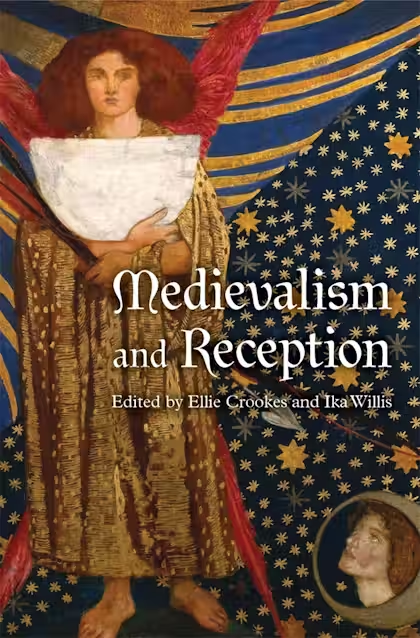
Our most recent joint appearance has been in Medievalism and Reception, an essay collection edited by Ellie Crookes and Ika Willis. Published earlier this fall by D.S.Brewer in their Medievalism series, the volume closes with Nazmi’s absolutely gorgeous “Hosting Chaucer’s Pilgrims in Turkish.” If you want to read about translating Chaucer from one of his best translators, get your hands on Nazmi’s essay.
And if you’re curious about role of translators in ensuring Chaucer’s readership, note this: Canterbury Hikâyelieri is in its 9th edition!
The Program Committee for the 24th Biennial Congress of the New Chaucer Society–to be held in Freiburg, Germany, 27-30 July 2026–has released its Call for Sessions.
The Call includes guidelines for submitting panel proposals to eight thread options:
Comparative Environmentalisms
Multilingualism and Mobility
The Social Lives of Medieval Books
Ubiquitous Medievalism
Precarity
Tales in Translation
Thinking with/through Ethics/Aesthetics
Open Topics
You will find complete descriptions of the threads as well as the submission process here.
The deadline for submitting a session proposal is 17 January 2025.
The ensuing Call for Papers will appear soon thereafter.
Kuddos to the program committee members Alastair Bennett, Gina M. Hurley, Koichi Kano, Julia R. Mattison, and Eva von Contzen (ex officio), led by committee co-chairs Mary Flannery and Ryan D. Perry.