The Miller’s Tale: Wahala-Dey-O! in Reykjavik!

2014-07-16 21.35.51by Candace Barrington

Chaucerians at the NCS Congress in Reykjavik, Iceland, were treated to a multi-media production of Ufuoma Overo-Tarimo’s The Miller’s Tale: Wahala Dey-O! on Wednesday, 16 July 2014 at the Tjarnarbíó across from City Hall. (At left, Jonathan Hsy, Ufuoma Overo-Tarimo, and Candace Barrington,)

The production begins with a live performance of Overo-Tarimo’s dramatic adaptation of The General Prologue set in Nigeria and draws on African folk traditions of storytelling intermingled with music, drums, and gossip. Once the storytelling framework is established, the production moves to a filmed adaptation of The Millers Tale.  Overo-Tarimo had planned to use live actors in this segment–just as she had in her production at Edinburgh’s 2012 Fringe Festival. Because, however, key Nigerian actors were unable to secure visas, she shot a pilot film of the play in Nigeria.

Overo-Tarimo’s adaptation of The Miller’s Tale incorporates many explicit Nigerian elements. As she explains,

“Nigeria as a nation is made up of many tribes and I try to reflect this reality in the various characters. For example, Abusolon’s character is from the North of Nigeria who has moved to Ibadan in the West of Nigeria to start a new life. As a refugee, he is particularly sensitive because of the massacre experience of his family and village in the North where traumatic killings have taken place and still happening.  Hence, security is one of the most challenging issues for the country with the rise of Boko Haram and other terrorists groups. His dream is to eventually move abroad to the UK or US, where he believes all his problems will be solved. In t he meantime, he falls in love with Alice, who taunts and rejects his love and adds to his torment. Nikori is from the same Urhobo tribe as the carpenter; hence, he enjoys partial treatment and is implicitly trusted by the carpenter. … “Julie you too like money” is a stereotypical reference to Julie’s [a servant in Carpenter John’s household] Igbo tribe, who are known to be industrious, and Alice’s love of dressing and partying is reference to her Yoruba tribe’s uwambe ‘good time’ associations. Rabiu [another servant] is from Akwa Ibom, a tribe known for their domestic hard work and loyalty.”

The songs of Abusolon/Absolon are based on Nigerian styles. The dialogue is conducted in a mixture of Nigerian Pidgin English and the Queen’s English, thereby establishing social divisions and enlivening the comedy.  Nikori/Nicholas, the university student who seduces Alice/Alisoun, uses a form of black magic, a cultic practice associated in Nigeria with some universities. Throughout, the bane of Nigerian urban life–the blackout–weaves its way through the tale, ultimately providing the context for the misdirected kiss and Abusolon’s retribution.

The cast in both the live and the filmed portions reflect the production’s international flavor. Hailing from Nigeria, Britain, and Iceland, they made Overo-Tarimo’s The Miller’s Tale: Wahala Dey O! a global Chaucer.

2014-07-16 21.41.00

(At left, Candace and Jonathan with the cast from the live production.)

Update on Ufuoma Overo-Tarimo’s production of The Miller’s Tale: Wahala-Dey-O.

index
by Candace Barrington
Because Ms Overo-Tarimo was unable to obtain necessary visas for her actors, there will not be a live performance of her acclaimed adaptation of The Miller’s Tale. Instead, Chaucerians will be treated to an exclusive showing of her film version of the play on Wednesday, 16 July, at 7:00, immediately after the Reception hosted by the mayor. The screening will take place at Tjartnabio, a theatre building opposite City Hall (the site of the reception).
Seating is limited to 160, so I advise you to purchase your tickets as soon as possible. Tickets are available online or at the door for ISK 2500 apiece.
To learn more about The Miller’s Tale: Wahala-Dey-O and its fascinating origins and its storied production history, please see my earlier blog posting.

Pilgrim out of town: Chaucer’s Modern Echoes

by Gail Ashton

St. Pancras, Gray’s Inn Road, to Holborn… Holborn viaduct with its knight flanked by two dragons guarding one of the old city gates…on to Cheapside, Poultry, Bankside…and there ahead London Bridge streaming with traffic and people: to the left, upriver, Tower Bridge, to the right St. Paul’s Cathedral, and the dirty old River Thames chopping and surging below and everywhere crowds walking as if they know where they’re going, contemporary buildings scraping the skyline. And, as if from nowhere, Southwark Cathedral tucked into a hollow, its perfect rising tower the centrepiece to long sweeps of stone fanning out on either side.

This is the oldest church building in London. It stands at the oldest crossing point of the tidal river Thames and was for many centuries the only entrance to the city this side of the river. Some believe there was a place of worship here as far back as Roman times but the ‘modern’ cathedral was re-founded in 1106 by 2 Norman knights. It has had a long and colourful history thereafter.

Yet, as befits this evening’s event with its title Chaucer’s Modern Echoes, this is not simply a medieval shrine but a building at the heart of contemporary life. It’s ringed by the Thames, by bridges and tenement-style wharfsides. In the closing years of the last century the Millennium Buildings were created where the priory of the religious community once stood. Soon there will be a new railway viaduct and the tallest building in Europe, the Shard, standing nearby. Around a corner and along an alleyway and here are the ruins of Winchester Palace, home to a host of medieval bishops. There’s a replica of the Golden Hinde ship, a sign to Shakespeare’s Globe Theatre, and the Clink Museum, site of the former Clink Prison, the oldest gaol in England dating back to 1140.To the left of the cathedral, the small busy Borough market is crammed beneath the railway viaduct, and all the time trains grind along the track, postmodern structures in glass and steel mesh lean into the cathedral yard, straining for a share of its light.

This is a narrow cathedral, the eye drawn to the altar with its small high window. I almost overlook John Gower’s gaudy tomb tucked into the wall and just beyond it Chaucer’s window which depicts the Canterbury pilgrims about to set off on their journey. And before I can even get in to look around I have to wait for the close of a memorial service dedicated to one Michael Cox, master vinter and part of a family owned UK wine company; it’s as if Chaucer has just stepped from the shadows for a last glance at the evening to come.

Tom Eveson and Gabby Meadows intersperse the performances with extracts from Troilus and Criseyde and The Canterbury Tales, Tom in his fabulous rendition of Middle English and Gabby with her mellifluous modern readings. I speak about Chaucer’s literary heritage and his contemporary afterlives with special nods to the fabulous LeVostreGC aka Brantley Bryant and to the medieval meme rendition of the Mamas and the Papas (I never thought I’d be singing in Southwark Cathedral). Lavinia Greenlaw took us on a narrative journey through her haunting A Double Sorrow. And Patience Agbabi blew the roof off with her dramatic performances from Telling Tales: Harry Bailly’s fictional biography; the Prologue’s Grime Mix; her Prioress’s Tale or the amazing Sharps an Flats; the sassy Things alias The Shipman’s Tale; Unfinished Business or the Melibee, her clever and disturbing mirror poem; before ending with Makar, the Franklin’s Tale.

Best of all, as we take turns to speak, in my left ear all night is the rumble and clatter of trains, a helicopter whirring, and Patience stepping into her Sharps an Flats with its call to Damilola stabbed in real life and left to bleed to death in a stairwell, a police siren wailing in time to Chaucer’s still ticking pulse.

My warmest thanks to Poet in the City, especially to Isobel Colchester, Suzy Cooper and Gabby Meadows for hosting and organising this amazing event. And too to the Dean of Southwark Cathedral for bringing over 300 people into such an iconic space.

Watch out for audio interviews when they’re released.

Poet in the City & Chaucer: Modern Echoes

logoAn update on the Poet in the City’s upcoming event, Chaucer: Modern Echoes.  Thanks, Gail!

Guest post by Gail Ashton.

The life so short, the craft so long to learn. Who said that?

I have been in Geoffrey Chaucer’s company for a quarter of a century now, one way or another. I’m still no nearer than the merest echo of him, and, truth to tell, if we met in a dark alley I don’t know which of us would be more afraid. I read books the whole night long. Come morning I’m convinced I know less than I did the day before , and sitting here with my student copy of Riverside literally falling to pieces before my eyes I have a horrible feeling of déjà vu.

The event is Poet in the City’s “Chaucer: Modern Echoes,” held at Southwark Cathedral 10 April 2014. I have done this once before at a similar evening in September 2012 somewhere in the depths of the British Museum, London, where Patience Agbabi thrilled us with trial runs of her then work-in-progress Telling Tales. And I met Professor Helen Cooper into the bargain. All this name-dropping! This time Lavinia Greenlaw (A Double Sorrow: Troilus and Criseyde) is on the bill with Patience. You will have heard all this, dear reader. What you might not know is that at 7pm this coming Thursday, someone is going to ask me to talk about our Geoffroi.

When I open my mouth I fear I’ll have nothing to say and – heaven forfend – if I’m called as any kind of expert witness in audio-interview, then the world will see that after all I know nothing, and the only sound from this old house of fame will be but babble whirled into London skies.

If you can, be there. Just don’t expect any authority.

The others are worth listening to over and over. And the cathedral has cake, I’m told, if you’re early enough.

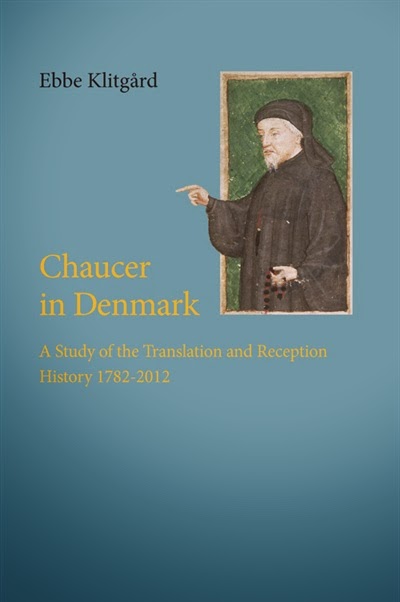
Review of Chaucer in Denmark at Medievally Speaking

by Candace Barrington

DenmarkAn early contributor to the Global Chaucers blog, Ebbe Klitgård, published his one-of-a-kind study, Chaucer in Denmark,  in 2013.  I had the opportunity to review it for Medievally SpeakingWithout reprinting the entire review, I draw your attention to my final admonition:

With the commendable precedent for the study of Chaucer’s non-Anglophone reception now in place, Chaucerians and medievalists should encourage similar studies by our colleagues in predominately non-Anglophone universities and cultures.  Such work enriches the study of Chaucer in important ways, yet its survival is not necessarily ensured.  Because we know first-hand the difficulties of maintaining medievalist lines in English departments where we serve an English-speaking student population, we should be sympathetic to the even more precarious situations of Chaucerians housed in foreign-language departments. By attending to what they can tell us, ordering their books for our campus libraries, and by incorporating their research and translations into our own studies, we can support their important work and their careers.  We have just begun to listen to them; it would be shameful to lose their voices now.

Ebbe will be at the NCS Congress in Reykjavik this summer and one of the panelists on the Global Chaucers Roundtable, where his topic will be “Chaucer in Denmark since 1945: A Discussion of Some Adaptations and Translations, with a Focus on Illustrations”

The Miller’s Tale: ‘Wahala Dey O!’

by Candace Barrington

WahalaDeyOh

We have great news for Chaucerians in Reykjavik this summer for the New Chaucer Society Congress! We’ve learned that Ufuoma Overo-Tarimo will be staging her adaptation of The Miller’s Tale to coincide with the conference in July.  Written in both Nigerian Pidgin and English, The Miller’s Tale: ‘Wahala Dey O’ had its premier at the 2012 Edinburgh Fringe Festival and received a four-star rating and glowing reviews

Ufuoma’s adaptation draws on her background: born in Nigeria and raised in Britain, she is a former student of Sif Rikardsdottir (the Icelandic Chaucerian heading the conference’s local organizing committee); she took Sif’s “Chaucer and the North” course.  She wrote in the play in 2006 while studying for her Masters in English.  Based on the snippets of the play that I’ve viewed on YouTube, I wasn’t surprised to learn she had previously studied Philosophy and History of Religion at King’s College, London University and later studied at the College of Law.  That legal trajectory changed when she moved to Iceland with her husband in 2004 and began graduate study in English.  And even that journey has taken a side trip.

She explained it to me this way:

I discovered play writing and feel very passionate that this is a sound way to get people who would otherwise not care for Chaucer right into the heart of Chaucer’s work. The Edinburgh Fringe proved this right.  As the play attracted all and sundry from curious Chaucerians, English Professors, bored students, wanderers, homesick Nigerian/English expatriates and colonialists, and those in search of a good time…

Chaucerians at the Reykjavik conference will get a chance to meet Ufuoma and to see her play.  We will keep you posted on the performance schedule and how to purchase tickets.