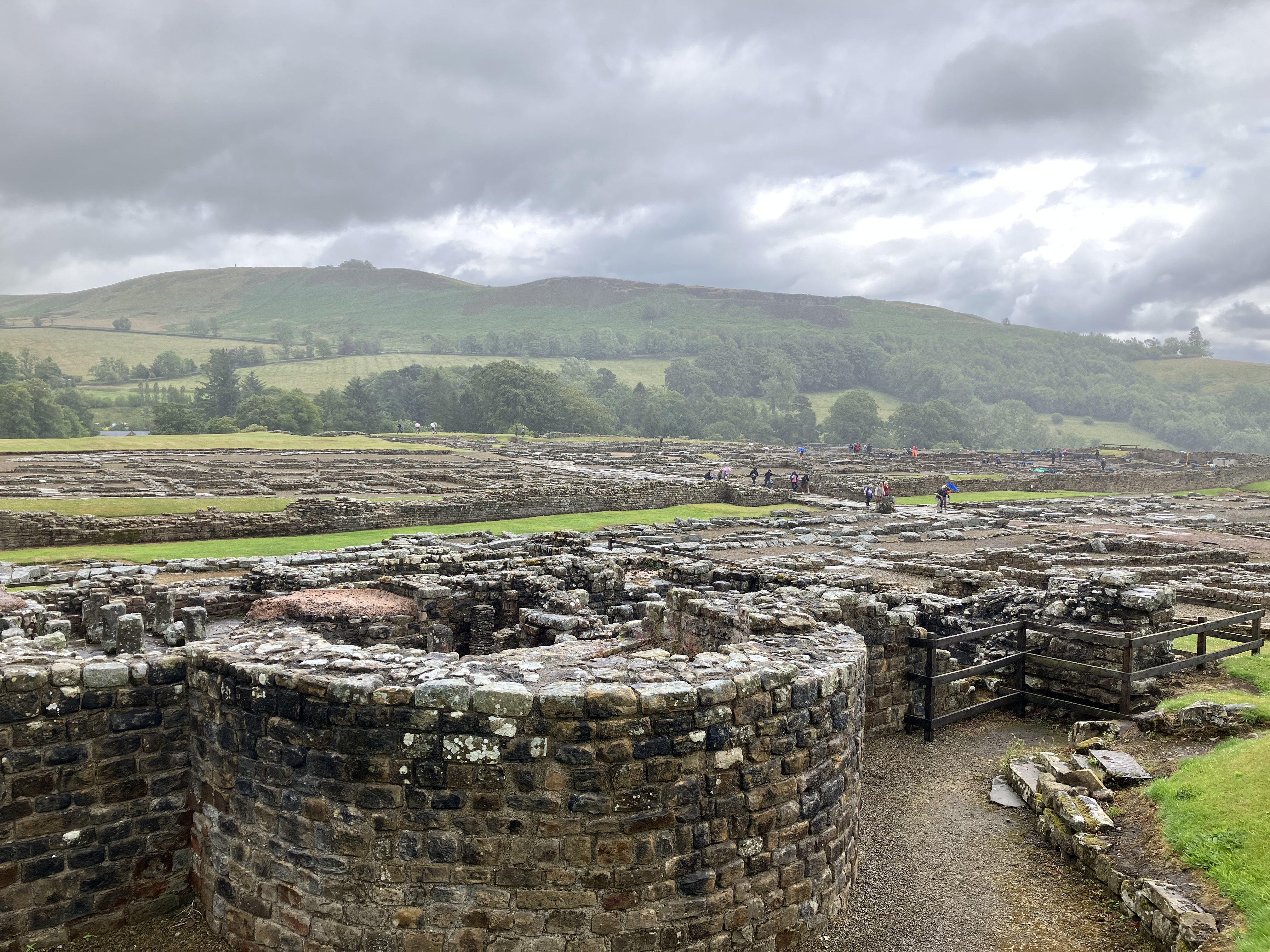
Vindolanda: destination for one of three NCS excursions and excellent reminder of the many peoples involved in the Roman colonial project.
The 2022 NCS Congress featured an inspiring number of sessions with a global or multi-cultural perspective. And a good number of presenters were from non-Anglophone backgrounds, though many were unable to attend in person because of visa, funding, and pandemic restrictions.
Because there’s still a chance for you to view the Congress sessions and uploaded presentations–here’s a quick list of the papers/sessions dealing with Chaucer’s reception, global and otherwise, that I attended.
Papers
Jacqueline Burek, “Translating Troilus: The Welsh Troelus a Chresyd“
Louise D’Arcens, “The Kangaroo Kelmscott: Chaucer’s Sydney Afterlife and Australian Deep Time”
Aistė Kiltinavičiūtė, “Reimagining the Dream Poet: Edward Burne-Jones’s Dantean Chaucer”
Usha Vishnuvajjala, “Feminist Medievalisms and Chaucer in Jane Austen Fanfiction”
Wajid Ayed, “Chaucer in Tunisia: 50 years”
Raúl Ariza-Barile “From Southwark to the Citee of Mexico: Producing the First Ever Mexican Translation of The Canterbury Tales”
Lian Zhang, “Translation as Remembering: Canterbury Tales in Chinese”
Yoshiyuki Nakao, “How to Translate Chaucer’s Multiple Subjectivities into Japanese: Ambiguities in His Speech Representation”
Amy Goodwin, “Chaucer in the New York Times”
Jonathan Hsy, “Racial Displacements: Chaucerian Poets of Color and Critical Refugee Studies”
Jamie Taylor, “Indigenous Studies and a Global Middle Ages”
Candace Barrington, “Comparative Translation: Possibilities and Limitations”
Jonathan Fruoco, “Is there an Embargo on Chaucer in France?”
Marion Turner, “The Wife of Bath’s European Lives”
Plenary Sessions
“Where Medieval Studies Joins Up,” a plenary conversation chaired by Jonathan Hsy featuring
Anthony Vahni Capildeo
Wallace Cleaves
Ananya Jahanara Kabir
The Refugee Tales, with Patience Agbabi
The Polyglot Miller’s Tale Reading
If you were a registered participant at the Congress, you can view the sessions and individual papers.
Go to ncs2020.net
Click on Attendee Hub and log in just as you did during the Congress
Select “All Sessions” on Schedule pull-down menu (upper)
Search for the speaker’s name, then follow the links to replay either the session or watch the uploaded presentation.
These links will remain available until mid-October.
In a happy reprise of the spontaneous (but very jolly) Polyglot Reading of The Miller’s Tale at the 2014 NCS Congress in Reykjavik, 14 Global Chaucerians gathered to read the tale in 9 languages (in addition to Middle English).
1.3109-3135, Middle English, Candace Barrington and Jonathan Hsy
1.3136-3166, Welsh, Jacqueline Burek
1.3167-3220, Spanish, Amanda Gerber
1.3221-3287, Lithuanian, Aistė Kiltinavičiūtė
1.3288-3338, 19c French, Juliette Vuille
1.3339-3398, German, Lucy Fleming
1.3399-3467, Arabic, Wajih Ayed
1.3468-3525, Italian, Sarah McNamer
1.3526-3588, Hebrew, Noa Nikolsky
1.3589-3656, German, Lucy Fleming
1.3657-3726, French, Jonathan Fruoco
1.3727-3785, Korean, Mariah Min
1.3786-3854, Italian, David Wallace
Some special highlights include
the premier of Jonathan Fruoco’s new French prose translation of the tale,
the first ever translation into Welsh thanks to the intrepid Jacqueline Burek,
the introduction of Korean slang and dialect into Mariah Min’s reading,
Lithuanian (need we say more?),
a sequenced chorus of Alisoun’s “Tehee” (3740), and
a recording, now streaming and available through mid-October to those who registered for the congress (either in person on online).
And, of course, lots of laughter.
In addition to thanking our fabulous readers (both new ones and repeat participants) for their full-hearted participation, we owe our deep gratitude to
Mary Flannery for initially inviting us to resume the reading at the soon-to-be postponed 2020 Congress,
Julie Orlemanski and Phil Smith for juggling schedules to ensured the reading happened in 2022,
Patience Agbabi and other members of our audience for supporting us with their presence and laughter,
Annette Kern-Stachler, Lian Zhang, Raúl Ariza-Barile kept away by the complications of pandemic-era travel, and
Durham University’s excellent tech staff who smoothly orchestrated the recording and transmission of the event.
If you were a registered participant at the Congress, you can view the streaming broadcast of the reading.
Go to ncs2020.net
Click on Attendee Hub and log in just as you did during the Congress
Select “All Sessions” on Schedule pull-down menu (upper)
Search “polyglot,” then click on “Polyglot Miller’s Tale Reading”
Click on “replay”
After lots of preliminaries, the actual reading begins at 17 minutes and ends at. 59.30
Plans are already brewing for 2024. Let us know if you’re interested in participating at globalchaucers at gmail dot com.
The Guardian reported on 12 November 2019 that Zadie Smith (author of White Teeth among other notable novels set in contemporary London) is adapting The Wife of Bath’s Tale (but I suspect they mean her Prologue) for the borough of Brent’s 2020 program marking it as a “borough of culture.” Titled The Wife of Willesden, this first play by Smith will be a monologue performed at Kiln Theatre. The article reported that, per Smith, the piece will “raise questions about the place of women in society and aim to capture the voice of Brent.”
By adapting the Wife as a vehicle for a distinctively localized and contemporary voice, Smith is not alone. Jean “Binta” Breeze’s “The Wife of Bath in Brixton Market” and Patience Agbabi’s “The Wife of Bafa” have adapted the Wife’s monologue for voices associated with the African Diaspora. (See Jonathan Hsy’s posting where he describes how he incorporates their work into his classroom teaching.) In Brazil, Francisco Botelho has adapted his Brazilian-Portuguese translation of The Wife of Bath’s Prologue into a one-woman dramatic monologue.
We’ll keep an eye on updated information on Smith’s Chaucerian play. And for those wanting to see a performance, we will post dates and ticket information as soon as they appear.
World Map by Ranulf Higden, British Library, Royal MS. 14 C.IX, ff.1v-2r.
by Candace Barrington
The 2019 Biennial London Chaucer Conference was held 28-29 June at St Bride’s Foundation, not far from where Wynken de Worde established his Fleet Street press (soon after printing his 1498 The Canterbury Tales in Westminster). The conference’s announced theme, Chaucer and Europe, only hints at the deeply international nature of the presentations, as I think the following summaries of select papers suggest.
David Wallace opened the proceedings with his plenary “Italy Made Me: Chaucer and Europe,” reminding us that the essential anti-Mediterranism at the foundation of Chaucer Studies (see for example Lewis’s “What Chaucer Really Did to Il Filostrato”), with its hard line dividing northern “Germanic” Europe from southern “Latin” Europe, was a useful fiction that does not correlate with the fourteenth-century Europe Chaucer knew.
In the “Chaucer and Boccaccio” panel, Leah Schwabel’s “‘Oon seyde that Omer made lyes’: Chaucer’s Intertexual Poetics” noted that Chaucer’s failure to identify Boccaccio as his source complied with classical translation practices that obscured and distorted sources; therefore, we should reconsider how we identify intertexual resources and look beyond echoes to modes of borrowing. During the Q&A, Kenneth Clarke reminded us that there is only one extant fourteenth-century manuscript of the Teseide, and that one is Boccaccio’s autograph; no one at the time seems to have read more Boccaccio than Chaucer [correction 7/13/2019*]. Clarke’s own presentation, “Medieval Humanism and Vernacular Poetics: Chaucer, Ovid, And Ceffi,” established that the gamma iteration of Fillipo Ceffi’s Italian translation of Ovid’s Heroides was one of the sources for the Legend of a Good Women, further complicating the network of European texts and books that Chaucer responded to.
In the Chaucer and Machaut panel, Juliette Vuille’s “French Kissing and Ménage à Trois: Machaudian influences in Chaucer’s metapoetic Pandarus” considered what Chaucer learned from Machaut regarding poetic voice and the process of invention. David Levinsky’s “European Peripheries: Machaut and the Monk’s Tale” looks to the tale’s four “modern instances” to consider the limits of exemplary and historical writing.
The Global Chaucers round table began with Ana Sáez-Hildago’s presentation on the earliest Spanish translation of Chaucer: a 1914 children’s book based on the British Tales from Chaucer. Preceding by seven years a full translation of The Canterbury Tales into Spanish, the small volume went through five printings across five regimes (1914-1956). Candace Barrington introduced some less-obvious Chaucerian influences in Tomáš Zmeškal’s 2008 Milostny dopis klínovym písmem (Love Letter in Cuneiform, translated by Alex Zucker in 2016), whose narrator was shaped by Chaucerian “misdirection.” Lydia Zeldenrust introduced us to an in-process Frisian translation of
Lydia Zeldenrust. Thank you, David Wallace, for posting this photo on FB.
the Tales. Because Frisian is a marginal language seldom written and with a small written literary tradition, Klaas Bruinsma’s project is to create a foundation of translated works on which to elevate a Frisian literary tradition. (Sounds very Chaucerian!) David Wallace kicked off the room discussion with an insightful response that asked us to consider what this reception history reveals about our own readings of the Tales.
The first day wrapped up with Laura Kendrick’s “Chaucer and Deschamps.”
The conference’s second day opened with a fascinating round table discussing the recently published Middle English Travel: A Critical Anthology, edited by Anthony Bale and Sebastian Sobecki. Designed for undergraduate use, the volume includes essays on travel-related topics, an anthology of medieval travel texts, and contextualizing material (such as maps and charts). Together, the entries help reveal the hitherto underestimated capabilities of these travel writers.
In the following session entitled “Senses and Emotions,” Eleanor Myerson’s “Mamlūk Spices and Medieval Digestion” stood out for its identification of connections between Chaucer’s family and the spice trade, connections which help elucidate his textual references to the remedial properties of spices.
After lunch, Patience Agbabi framed her readings from Telling Tales and The Refugee
Patience Agbabi
Tales with a discussion of the importance of both celebrating verse as well as acknowledging storytelling’s therapeutic effect as a validator of traumatic experiences.
In one of the two final concurrent sessions, “European Afterlives,” Lotte Reinbold’s “A Diluted Drink: Dreaming Troilus and Criseyde” examined how Kynaston’s 1635 Latin translation removes ambiguity in Troilus’ dream of the eagle removing his heart, thereby rendering the text more tragic and suitable to his audience’s tastes. On the same panel, Sarah Salih returned to The Refugee Tales, which indirectly argue that we should be more like our medieval predecessors, making the collection an outlier in the work that the medieval does in the present day. The Refugee Tales is able to make this argument by reimagining the medieval past as a tolerant, multicultural one we’d like to emulate. As Salih makes clear, this sort of recreation doesn’t need to be condemned, but it does need to be correctly contextualized.
Marion Turner closed the conference with “Chaucer’s European Life.” Chaucer’s diplomatic journeys would have given him a close-up view of more tolerant, multicultural societies such as Naverre. And his bureaucratic jobs in London would have shown him how tightly connected English politics and economics were tied to those on the continent.
Many thanks to Alastair Bennett and Hetta Howes for putting together an engaging conference that examined Chaucer from a more European perspective. It was a fabulous conference!
[These summaries are from my jet-lagged notetaking at the conference. If I have misrepresented anything, please contact me. I will make the necessary corrections or clarifications.–CB
The 2nd edition of Peter Brown’s A New Companion to Chauceris now available. Featuring 36 alphabetically arranged chapter topics–Afterlives, Auctorite, Biography, Bodies, Bohemia, Chivalry, Comedy, Emotion, Ethnicity, Flemings, France, Genre, Ideology, Italy, Language, London, Love, Narrative, Other Thought-Worlds, Pagan Survivals, Patronage, Personal Identity, Pilgrimage and Travel, Religion, Richard II, Science, The Senses, Sexuality, Sin, Social Structures, Style, Texts, Things, Translation, Visualizing, and Women–the volume is noticeably heftier than the 2002 edition.
Currently the companion’s first chapter is freely available for download. In a nice piece of irony that tickles our hearts, that chapter is the one Jonathan and I contributed. Though our chapter “Afterlives” deals those things that come last chronologically, its title comes first alphabetically, making real the injunction that “the last will be first.”
Our deepest appreciate to Carolyn Collette for suggesting we take up the topic in her stead, and our thanks to Peter Brown for incorporating us into his excellent lineup of scholars.
Patience Agbabi’s East Coast speaking tour has an additional date and locale: Monday, 13 November 2017, at Vassar College, Poughkeepsie, New York. If you’re in the vicinity, we highly recommend you make the effort to attend–and bring your students.
Patience Agbabi will be making one of her few U.S. appearances on 25 November 2017, 7pm, at Boston College. Her readings and performances are unparalleled, as those of us at NCS 2016 in London witnessed. If you’re in the area, don’t miss this opportunity.
In a bit of belated news, one of our favorite Global Chaucers, Patience Agbabi’s Telling Tales, was short-listed for the Roland Mathias poetry award as part of the 2015 Wales Book of the Year selections (English language category). Agbabi’s Welsh heritage adds another interesting dimension to her fabulous adaptation of The Canterbury Tales. (Thanks to Jackie Burek for the tip!)
Cover of Refugee Tales (forthcoming from Comma Press, 2016).
Refugee Tales is now available for purchase as an e-book (or pre-order a hard copy)!
This collection includes the contributions by Patience Agbabi (former Poet Laureate of Canterbury and author of Chaucerian remix Telling Tales), as well as other artists and storytellers from varied backgrounds. (We’ve mentioned Agbabi’s work throughout various blog posts, and you can read more about the “Refugee Tales” project here; see also my related posting on the global refugee crisis at In The Middle.)
Refugee Tales is a multi-voiced collection that conveys “the frighteningly common experiences of Europe’s new underclass – its refugees. … Presenting their accounts anonymously, as modern day counterparts to the pilgrims’ stories in Chaucer’s Canterbury Tales, this book offers rare, intimate glimpses into otherwise untold suffering” (read more on the Comma Press website).
I’ve already acquired the e-book and can already say that the poetry and stories in this book are at once beautiful, provocative, and moving.
Note there are many events happening in July 2016 (before and throughout the New Chaucer Society Congress in London) relating to the Refugee Tales project; see event listing here (note the forum and various scheduled legs of the walk, a “reverse” pilgrimage along the route from Canterbury to Westminster).
Upcoming events of interest:
Friday, 8 July 2016: Presentations from Refugee Tales at the Institute of Contemporary Arts in London. Ali Smith,”The Detainees Tale”; David Herd, “The Prologue;” and Patience Agbabi, “The Refugee’s Tale.” [Book tickets here – SOLD OUT as of 10 June]
Wednesday, 13 July 2016: Reading by Patience Agbabi coinciding with the New Chaucer Society Congress in London; she will deliver an interactive reading entitled “Herkne and Rede” drawing from Telling Tales that explores poetry performance as dynamic adaptation. [This is a public event. Scroll to the end of this schedule; more info will be forthcoming on this blog]
Taking a cue from Chaucer’s band of pilgrims, participants in Gatwick Detainees Welfare Group’s Refugee Tales Walk are midway through their 9-day walk on the North Downs Way from Dover to Crawley via Canterbury. Along the way, writers, musicians and other artists will share tales inspired by the migrants and refugees: The General Prologue, The Migrant’s Tale, The Chaplain’s Tale, The Unaccompanied Minor’s Tale, The Arriver’s Tale, The Lorry Driver’s Tale, The Visitor’s Tale, The Detainee’s Tale, The Interpreter’s Tale, The Appellant’s Tale, The Counsellor’s Tale, The Dependent’s Tale, The Friend’s Tale, The Deportee’s Tale, The Lawyer’s Tale, The Refuge’s Tale, The Ex-Detainee’s Tale, and a Reprise of the Tales.
Photos and journal entries provide the rest of us an opportunity to share in the events.
Thanks to Dan Kline for alerting us to this deeply moving project.



 The 2nd edition of Peter Brown’s


