Much of the history of the Global Chaucers project could be written be detailing a series of chance encounters and missed opportunities. One of the more recent examples of a chance encounter was my meeting Danko Kamčevski (Metropolitan University of Belgrade) this past November at the Chaucer in the Age of Medievalism conference at the University of Lorraine (Nancy, France). He not only knew about Boris Hlebec’s 1983 Serbian translation–Džefri Čoser’s Kanterberijske priče–but offered to send me a copy. Indeed, just a few days after the conference, he wrote that he’d found a copy and gone to the post office to mail it, only to be informed that, in response to the ongoing tariffs, the Serbian Post Office does not allow packages to be sent to the United States.
Meanwhile, Danko has shared a careful explication of Hlebec’s translation of a passage from The Knight’s Tale as well as forwarded Sergej Macura’s 2025 article examining the metrical and lexical equivalences between Chaucer’s Middle English General Prologue and Hlebec’s translation. He has also notified me that Professor Hlebec has recently died. Never getting to correspond with Chaucer’s Serbian translator is my missed opportunity.
Eventually, I’ll find a way to get Kanterberijske priče, and both Danko Kamčevski’s explication and Sergej Macura’s article will contribute significantly to my current writing project. I do wish, though, that I could have thanked Professor Hlebec for his contributions.
Compiler’s note: The annotated list shared here is the result of serious sleuthing through archives, libraries, and used bookstores, but it is by no means fully comprehensive. My interest in Korean translations of the Tales has two originary moments: one is when I located a rarely-discussed abridged translation of the Tales in the collected works of Choe Nam-seon, among his early 20th-century serializations of “world literature” in translation, and another is when I chanced on a previously undocumented translation of the Tales (“Fake Kim B” below) while shopping for a recommended translation (“True Kim” below). Both ‘discoveries,’ while interesting in themselves, also show that there may be more such translations not discussed here, including partial translations or individual tales. Kang and Choi’s study mentions a lost translation, Kwak Jang-hyun’s 1962 publication, a copy of which they (and I too) failed to locate. A children’s version of the Nun’s Priest’s Tale has been previously identified in the Global Chaucers database. I also note that post-separation North Korea may hold translation archives to which I did not have access. This list may well be updated in the future, and I would be more than happy to receive queries or tips at yeajung.park at slu.edu.
The “CHOE N.” text (CHOE Nam-seon 최남선, 1915-17). Prose; partial and abridged [7 tales]; indirectly translated. Abridged versions of the following: General Prologue; The Knight’s Tale; The Clerk’s Tale; The Franklin’s Tale; The Pardoner’s Tale; The Wife of Bath’s Tale; The Nun’s Priest’s Tale (misnamed as the Nun’s Tale); The Prioress’s Tale. Published as one of the major Western classics under the heading of “세계문학개관” [Introduction to World Literature] in the magazine “청춘” [Youth], this translation was made by Choe Nam-seon, a cultural activist, literary translator and critic who is now also considered the first Korean “modern” poet. Choe’s source, an abridged Japanese translation, was identified only recently in 2018 (see Kim reference). Although Choe worked indirectly, many of his rhetorical flourishes are original, using onomatopoeia and action words that fill out the Japanese base text in ways that create effects surprisingly similar to Chaucer’s vernacular. The opening, an abbreviated version the General Prologue, is reworked into a musical rhythm and vocabulary that echoes the rhetoric of traditional Korean genres such as pansori (musical story-telling genre) or early vernacular soseol (novel). The links to traditional Korean genres, immediately recognizable to today’s Korean readers as hailing from Korea’s premodern vernacularity, create an interesting temporal effect, marking the text as something with a deep linguistic and literary past without the artificial interventions of a consciously “antiquating” translation. Kang and Choi point out that communicating the “feel” of Middle English to modern Korean readers poses a particularly difficult challenge for translators (p. 233); translated artifacts from Korea’s own literary past provide one good way of meeting this challenge. Presenting students with the Choe text as Chaucer’s “first encounter” with the Korean reading public will prompt simultaneous critical attention to the historical particularities of Chaucer’s language and to Chaucer’s afterlife and global transmission history.
The “TRUE KIM” text (KIM Jin-man 김진만, 1963). Prose, versified in later reprints by adding line-breaks; full and unabridged; directly translated with reference to other translations. Kim Jin-man, one of Korea’s pioneering scholars of medieval English literature, published a full translation of the Canterbury Tales in 1963, the first to include all of the Tales and also the first known translation to work directly from Middle English. As mentioned above, Kim’s translation is generally considered the “best” Korean rendition of the Tales, and has been reprinted several times. Kim names F. N. Robinson’s Works of Geoffrey Chaucer (1957, 2nd ed.) as his source text, showing that he chose an up-to-date and authoritative version at the time of translation. At the same time, Kim cites other translations, including modern English renditions by R. M. Lumiansky and Nevill Coghill, a French translation (Les contes de Canterbury by L. Cazamian and others), and Junzaburō Nishiwaki’s Japanese translation (『カンタベリー物語』). The plethora of sources that fed into this translation highlight the fact that even the most academically acclaimed translations rarely constitute an isolated exchange between the original text and the genius of the translator; it is a cultural amalgam that becomes rich through, not despite, multiple vectors of influence. Kim’s stated multivalent translation practice and its eminent success supports both the usefulness of considering multiple translations of the same text together, and the inclusion of indirect translations such as Choe’s in the scope of such considerations.
The “FAKE KIM A (GIANT BOOKS)” text (1982). Prose; partial [General Prologue and 9 tales]; possibly indirectly translated. Discovered by Kang and Choi to be a separate translation from Kim’s authentic 1963 text, this translation circulating under Kim’s name was published in 1982 by Moongongsa as part of the “Giant Books” series of world’s classics and Korean must-reads. Although Kang and Choi condemn this translation as one filled with errors and mistranslations (pp. 238-42), some readers have noted that the Korean prose of this text is much more readable than more literal academic translations. The focus on readable prose, perhaps the hallmark of heavy editorial processing, marks this text as the forebear of later prose translations such as Song’s, visibly geared toward a general reading public rather than academics or students of English literature.
The “FAKE KIM B (DONGSEO)” text (1987). Prose; full and unabridged; possibly indirectly translated. The publishing house Dongseomunhwasa (Dongsuh Publishers) published an authentic reprint of Kim’s translation in 1975, but the 1987 reprint (acquired by accident while searching for the “True Kim” text) is yet another separate translation. The book faithfully reproduces Kim’s 1963 introduction, but surreptitiously adds Michio Masui’s Japanese translation from the 1970s to the list of translations credited. This addition hints that the “ghost translator” behind this text either incorporated Masui’s translation or used it wholesale as the mediating source. The text also shows influence from modern English translations not initially mentioned by Kim, such as a telling reference to the “scent of fruit” in the first line of the General Prologue (that can only be a residue of the rhyming efforts of J. U. Nicolson’s 1934 translation, which runs: “When April with his showers sweet with fruit / The drought of March has pierced unto the root”; my emphasis). This “questionable” version was a surprising crowd favorite among my sample readers, who remarked on its resonance with the overall tone of 1980s Korean literature and chose it as one of the most pleasurable reads along with the “True Kim” text. However questionable the provenance or presentation, a new full translation of the Tales is a muscular feat, and it is worth noting that the Korean market produced yet another one at this time.
The “SONG” text (SONG Byeong-seon 송병선, 2000). Prose; full and unabridged; directly translated with reference to other translations. Translated by Song Byeongseon, a scholar of Spanish literature, this text does not immediately earn the approval of English literature scholars such as Kang and Choi, but the fact that this translation managed to edge out both the iffy Kim reprints and the roughly contemporary Lee & Lee translation in the market is interesting. This translation is currently by far the easiest text to acquire, sold in multiple editions in bookstores, and thus sports the largest number of online reader reviews to date, though likely soon to be overtaken by the newer Choi Yejung translation discussed below. (For the numbers of reviews, I referred to the websites of two major Korean booksellers: Kyobobook and Aladin.) The translation was re-released in an abridged version geared toward young adults in 2007, with comic subheadings added to each tale (e.g., “If your story’s good, your meal is free” for the General Prologue). The translation claims to be based on both Middle English and Spanish; the translator names John H. Fisher’s Middle English edition, The Complete Poetry and Prose of Geoffrey Chaucer (1977), noting its basis on the Ellesmere manuscripts as the reason for his choice, along with a Spanish translation (Los cuentos de Canterbury, 1991). Song’s nod to the manuscript tradition of the Tales displays the kind of interest in faithfulness and rigor increasingly expected of Korean translations, but his use of a Spanish help-text marks this translation as a participant in the tradition of multiply-translated texts that still impacts the Korean literary market.
The “LEE & LEE” text (LEE Dongill & LEE Dongchoon 이동일 & 이동춘, 2007). Mix of prose and verse; full and unabridged; directly translated. This collaborative translation by English professors Lee Dongill and Lee Dongchoon was the first in the several decades following Kim’s original translation to claim special expertise in Middle English literature. Parts of the translation were published earlier in 2001 and 2004 from Hanwool Publishing. The translation takes as its source the 1987 edition of The Riverside Chaucer, edited by Larry D. Benson. The translation is deemed “highly accurate” by Kang and Choi (p. 255), but the focus on accuracy of sense rather than ease of reading or communication of ambience contrasts with the efforts made by Kim to recreate the tone of particular speakers. The translation generally follows the original’s choice of verse or prose, as witnessed in the earlier partial publications of this translation, but the consolidated full edition cited here sometimes renders verse tales into prose (perhaps due to length issues or editorial choice). The general consensus among readers is that this translation is not a standalone reading text, but a near-literal translation that Korean students of Chaucer can lean on when struggling with the original Middle English.
The “CHOI Y.” text (CHOI Yejung 최예정, 2022). Mix of prose and verse; full and unabridged in two volumes; directly translated. Translated by Choi Yejung, a Korean scholar of Middle English literature who has previously conducted comparative critiques of existing Chaucer translations herself, this very recent publication takes The Riverside Chaucer (3rd ed.) as its source. In choosing verse or prose form, the translation faithfully follows the original. It also has the interesting distinction of being the first translation to deploy the polite register (hasipsio-che) of Korean throughout the main narration, resulting in a more conversational yet elevated tone overall than the ‘plain’ formal style (haera-che) of earlier translations. (There is some variation in register and speech level to reflect particular speakers’ character and mood, an element that can be witnessed in other translations as well; comparison of register choices among translations will be an interesting comparative project specific to the Korean-language scene.) Erudite but also very readable, even a smidgen too casual at times, this translation seems likely to become the new standard edition for Korean readers, especially as part of the acclaimed world’s classics series from the publishing house Eulyoo.
The revised “LEE & LEE” text (LEE Dongill & LEE Dongchoon 이동일 & 이동춘, 2007). Mix of prose and verse; full and unabridged; directly translated. A revised version of the 2007 text, created for Minumsa’s long-running world literature series. In the translators’ preface for this edition, Lee and Lee state that revisions were made in the interest of clarity for each line and for the general context, and that they paid extra attention to the meaning of the original Middle English. They expressed regret that Chaucer’s verse rhythm is difficult to reproduce in Korean. Based on comparisons of select passages, revisions appear to be mainly cosmetic (word choice, punctuation). A fuller comparison will give an interesting vision into how the same set of translators can make different textual choices over time.
CHOOSE YOUR FAVORITE: I share some sample passages from each Korean translation drawn from the same sections of the General Prologue, with my English back-translations for non-Korean readers’ reference. (These back-translations will of course reflect my own understanding of the flavor of each translation; if you are a Korean-language reader and have a different back-translation to offer, please reach out!)
Comparing each translator’s treatment of Chaucer’s famous opening lines, particularly their seasonal language and vivid imagery, is a great way to begin appreciating the different stylistic choices and atmosphere-setting work of each translation. For detailed suggestions on using such passage comparisons in the classroom, see my article “Multiply-Translated Chaucer in the Korean Classroom,” which focuses on descriptions of the Wife of Bath in particular.
[Middle English]
What that Aprill with his shoures soote The droghte of March hath perced to the roote And bathed every veyne in swich licour. Of which vertu engendred is the flour; Whan Zephirus eek with his sweete breeth Inspired hath in every holt and heeth The tendre croppes… (General Prologue 1-7)
Bifil that in that seson on a day, In Southwerk at the Tabard as I lay, Redy to wenden on my pilgrymage To Caunterbury with ful devout corage, At nyght was come into that hostelrye Wel nyne and twenty in a compaignye Of sondry folk, by aventure yfalle In felaweshipe, and pilgrimes were they alle, That toward Caunterbury wolden ryde. (General Prologue 19-27)
[Choe N.] 때는 춘삼월春三月 망간望間 땅은 런던倫敦의 남부南部 싸우드웍(Southwork) [sic] 숫막 쇄금정鎖金亭이라. 캔터베리 치성致誠을 가랴고 적적寂寂한 복로 방房에 전전반측輾轉反側 홀로 누어 잠이 드냐말냐 하는 차에 꾸역꾸역 들어오는 이십구명二十九名의 행인行人이 다가튼 치성致誠길이나 제각금 다른 직분職分…
The time is spring, near the middle of the third month; the place is the tavern Swaegeumjeong [lit. ‘Padlock Inn,’ perhaps short for ‘Gold-decorated (Tabard) Inn’] in Southwark, a southern part of London. Meaning to go for devout prayers to Canterbury, as I lay alone and fidgeting in a quiet side room, on the brink of waking and sleep, come a-swarming in twenty-nine wayfarers, all on the same prayer-way but each from a different estate…
[True Kim] 사월달 달콤한 소나기가 삼월 가물을 속속들이 꿰뚫고 꽃을 피게 하는 습기로 온 세상 나뭇가지의 힘줄을 적시어 주면, 서녘바람 또한 잔나무 밭 애송이 가지의 끝과 끝 속에 감미로운 입김을 불어 넣어 준다.
When the month of April’s sweet showers pierce deep through the March drought, and when with the moisture that causes the flowers to bloom they drench the sinews of all the tree-branches of the world, the westerly breeze also offers to blow its mellow breath into the fine end-points of the baby branches in gardens of small trees.
이 계절 어느날, 나는 경건한 마음으로 캔터베리로의 순례를 작정하고, 싸작크의 타바드 여인숙에 투숙했다. 밤이 되자 그 여인숙에는 스물 하고 아홉 사람의 한 떼가 들었다. 우연히 동행이 된 형형색색의 이 사람들은 모두 순례자들이었고, 찾아가는 곳은 캔터베리였다.
One day in this season, I with a devout heart decided upon a pilgrimage to Canterbury, and found lodgings at Southwark’s Tabard Inn. When it became night, into that inn there entered a crowd of twenty people and nine. Having become companions by chance, these people of all shapes and colors were all pilgrims, and the place they were looking to head was Canterbury.
[Fake Kim A]
달콤한 4월의 비가 한차례 내리자 메말랐던 4월의 대지가 촉촉히 물기를 머금어 나무들은 생기를 되찾고 꽃봉오리도 벌어지기 시작했다. 숲 속의 나뭇가지와 무성하게 자란 관목은 서풍의 향긋한 입김으로 부드러운 작은 가지를 뻗는다.
After a round of sweet April showers, the parched earth of April [sic] held water moistly, so that trees regained their liveliness and flower buds also began to open. The branches in the woods and the lushly grown bushes stretch out soft small sprigs due to the fragrant breath of the west wind.
그와 같은 시절의 어느 날, 신앙심이 샘솟듯 솟아올라, 나는 캔터베리 사원을 향해 혼자서 길을 떠났다. 도중에 런던 변두리 사자크의 ‹타바드 여관›에 묵게 되었다. 우연히도 그 여관에 29 명의 일행이 묵고 있었다. 듣건대 그들은 신분도 직업도 달랐으나, 여행 중에 서로 만나 함께 다니게 되었다는 것이었다. 그들은 말을 타고서 캔터베리에 참례한다고 했다. 물론 나도 그들 가운데 끼어들었다.
One day in that same period, piety welling up like a fountain, I embarked alone on the road toward the Canterbury shrine. On the way, I happened to stay at the ‹Tabard Inn› in Southwark, in the peripheries of London. By chance, there was a group of 29 people staying there at that inn. As I heard tell, they were all different in status and profession, but met during their travels and joined to journey together. They were riding on horses to pay their respects at Canterbury. I of course edged my way in among them.
Sweet with the scent of fruit, the April spring rain Seeps into the dry tree-roots of March. And drenches moistly all the sap-filled branches of the world And makes the flower-buds burst open—just about then, The westerly breeze blows its mellow breath Into the tender buds of woods and trees.
이 계절의 어느 날, 나는 경건한 마음으로 캔터베리를 순례하고자 서더크에 있는 타바드 여관에 묵고 있었다. 어둠이 깔릴 무렵 스물아홉 명의 여러 계층이 우연히 만나 여관으로 몰려 들어왔다. 그들 모두 참배를 하기 위해 캔터베리로 가고 있었다.
One day in this season, In order to make pilgrimage to Canterbury with a devout heart, I Was lodging at the Tabard Inn, which was in Southwark. Just as dusk settled, twenty-nine people of various estates met by chance and crowded into the inn. They were all heading to Canterbury to pay their respects.
[Song] 은은하게 내리는 4월의 비가 3월의 가물었던 땅 속으로 깊이 파들어갔다. 그 비는 꽃을 피우기에 모자람이 없을 정도로 대지의 모든 나뭇가지를 촉촉이 적셨고, 서풍은 감미로운 입김으로 숲과 들판의 연약한 싹에 생기를 불어넣었다.
The delicately falling rain of April delved deep into the parched earth of March. This rain moistly drenched all of the earth’s branches, enough to make flowers bloom, and the west wind with its mellow breath blew a lively spirit into the frail buds of the woods and meadows.
이런 시기의 어느 날이었다. 나는 경건한 마음으로 캔터베리로 순례하기로 마음먹고 런던교 남쪽의 서더크 구역에 있는 타바드 여관에 묵고 있었다. 그런데 어둠이 깔릴 무렵 스물아홉 명의 무리가 이곳에 도착했다. 그들은 각양 각색의 계층에 속해 있었는데, 우연히 만나서 무리를 이루어 캔터베리로 향하고 있었다.
It was one day in this period. I had decided to make a pilgrimage to Canterbury with a devout heart and was lodging in the Tabard Inn in the Southwark area, south of London Bridge. Then just as dusk settled, a crowd of twenty-nine arrived at this place. They belonged to a diverse array of estates, and were heading to Canterbury, having met by chance and formed a group.
[Lee & Lee; differences in the 2023 revision in brackets]
사월의 달콤한 소나기가 삼월의 가뭄을 뿌리까지 깊이 꿰뚫을 때, 그리고 꽃을 피게 하는 촉진적인 힘을 지닌 그 촉촉함[축축함]에 모든 줄기가 적셔질 때 그리고 서풍 역시 달콤한 입김으로 모든 숲과 들판에서 부드러운 새순에 생명력을 불어넣고 있을 때…
When the sweet shower of April pierces The drought of March deeply unto the root, And when all branches are drenched in that moistness [wetness]. That bears the promoting power that makes flowers bloom. And when the west wind also with sweet breath Into the soft new buds in all woods and fields Blows living energy…
이 계절 어느 날, 캔터베리로 성지순례를 떠나기 위해 마음속 믿음 가득한 채 내가 머물고 있던 서더크에 있는 타바드 여관에, 저녁 무렵 다양한 계층의 스물아홉 사람이 우연히 일행이 되어. 단체로 [한 무리로] 그 여관을 찾았다. 그들 모두는 순례자로서 캔터베리를 향하여 가려는 의도를 지니고 있었다.
One day in this season, Into the Tabard Inn in Southwark Where I was lodging while faith was full in my heart In order to depart on pilgrimage to Canterbury, Around evening twenty-nine people of various estates Having become companions by chance. Visited the inn as a group [as one crowd]. They all were pilgrims And bore the intent of going towards Canterbury.
[Choi Y.]
4월의 달콤한 소나기가 3월의 메마른 뿌리까지 뚫고 들어가 줄기마다 물기로 촉촉하게 적셔 그 힘으로 꽃이 피어나던 때였습니다. 서풍이 향긋한 숨결로 온 숲과 들판에 생명을 불어넣어 보드라운 새싹이 돋아나던 때였지요.
When the sweet showers of April Pierced through to the dry roots of March And drenched with moisture each stem So that flowers would bloom through that power—this was the time. It was the time when the west wind with sweet breath Blew life into all the woods and meadows So that soft new buds began to grow.
이런 계절의 어느 날, 저는 매우 경건한 마음으로 캔터베리로 순례길을 떠날 채비를 하고 서더크 지방의 타바드라는 숙소에 묵게 되었습니다. 밤이 되자 그곳으로 스물아홉 명은 족히 되는 각양각색의 사람들이 들어왔습니다. 그들은 모두 순례자로서 캔터베리로 가는 길에 우연히 만나 동행하게 된 사람들이었습니다.
One such day in this season, I, with a very devout heart, Prepared to go on pilgrimage to Canterbury And happened to lodge at an inn called Tabard in the Southwark area. When night fell, into the place came Folks fully twenty-nine in number Of a diverse array of types. They all were pilgrims, And on the way to Canterbury Had met by chance, and begun to travel together.
Texts and translations cited (in chronological order)
Chaucer, Geoffrey. The Canterbury Tales. In The Riverside Chaucer, 3rd ed., edited by Larry D. Benson. Oxford University Press, 2008. 23–328.
최남선 (CHOE Nam-Seon), trans. “캔터베리記” [Tales of Canterbury]. In 『육당 최남선 전집』 [Complete Works of Yukdang Choe Nam-seon], vol. 13. 역락 Youkrack, 2003. Originally serialized in the magazine 『청춘』[Youth] during years 1915–1917.
강지수 & 최예정 (KANG Ji-Soo & CHOI Yejung). “‘각양각색의 사람들이 각양각색으로 이야기했노라’—『캔터베리 이야기』 번역 검토” [“Diverse folk diversely they seyde”: Korean Translations of The Canterbury Tales]. 중세르네상스영문학 [Medieval and Early Modern English Studies] 12.1 (June 2004): 225-56. Korean text, English abstract available.
김준현 (KIM Jun-hyun). “『청춘』의 ‘세계문학개관’ 저본에 대한 검토 (1)—최남선과 마쓰우라 마사야스(松浦政泰)” [Review on the Original Text of “World Literature Overview” in Cheongchoon (Youth)—Choi Nam-seon and Matsura Masayasu]. 사이間SAI 24 (2018): 9–41. The Tales are discussed on pp. 30-34. Korean text, English abstract available.
영미문학연구회 번역평가사업단 (Assessment of Translations of Major British and American Writers Project). “캔터베리 이야기” [The Canterbury Tales]. 『영미명작, 좋은 번역을 찾아서』 [British and American Literature: In Search of Good Translations]. Changbi, 2005. 245-265. Korean.
이동일 (LEE Dongill). “『캔터베리이야기』 한국어 번역의 문제점 고찰” [A Consideration of Problems in Korean Translations of The Canterbury Tales]. 영미연구 [Journal of British & American Studies] 36 (2016): 27–52. Korean text, English abstract available.
PARK, Yea Jung. “Multiply-Translated Chaucer in the Korean Classroom.” Literature Compass 21.1-3 (2024). http://doi.org/10.1111/lic3.12735. English.
On 5 March 2024, an interview between two Alirezas—Alireza Mahdipour (Chaucer’s Farsi translator) and Alireza Anushiravani (founder of the Iran Comparative Literature Society)—was broadcast as a webinar. Titled “Translation and Comparative Literature,” the interview introduced its audience to Mahdipour’s literary translations of English literature into Farsi before concentrating on his translation of Chaucer’s Canterbury Tales (published by Cheshmeh Press in 2023). As the audience learned, although a translated (and retranslated) Shakespeare has been available to Farsi readers for more than a century ago, Mahdipour’s translation of the complete Canterbury Tales into Farsi is a first.
During the interview’s opening introduction, Mahdipour was asked about his age. He reports answering that “Chaucer and I are almost coeval, since it so happens that I was born in 1341 (according to Persian calendar, of course, which is 621 years behind or ahead of the Christian calendar, and you may be marveled to know that we are now in 1403!). This joke that I carry on seriously is of some significance: Chaucer’s time and situation somehow overlaps with that of ours and this helps us understand him sometimes better than some of his own contemporary fellow countrymen. Hermeneutically speaking, to understand the historical author we have to recreate the context of his text, which is lost to us (according to Schleiermacher) and/or we attempt to associate ourselves with his mind (according to Dilthey) or still, a more modern (actually postmodern) view, we may grasp some of the author’s ideas, intentions, and meanings only when they coincide or overlap with those of our own, and this happens in occasions when (according to the phenomenological approach of Heidegger and Gadamer), there is a ‘fusion of horizon’ between the author and the translator, since they establish a broader context within which they come to a shared understanding.”
Mahdipour goes on to explain that “In my argument I simplified all the above philosophical considerations by claiming that all these considerations are happily met with our present condition in Iran, as we are now in 1403! For example, in addition to having the Puritan discourse of England’s Commonwealth period, we are provided with medieval Summoners, who survived, or rather were revived, after their hibernation during Iran’s short period of modernization half a century ago.”
When asked about his decision to translate Chaucer’s verse into verse (rather than prose), he adamantly responded that a prose translation would ruin the merits of the book, as happened when an earlier prose translation appeared and was quickly disregarded. Because Chaucer’s achievement includes his use of rhyme and couplets—which are common devices in classic Persian narrative poetry—Mahdipour sees Chaucer as the perfect opportunity for a Persian translator with a poetic gift. Indeed, translating Chaucer was a pleasurable challenge for Mahdipour, since Persian prosody requires a strict rhythm and meter throughout the whole text, a feature achieved due to the flexibility of Persian syntax and its abundance of rhyming words. Thus, in addition to living in “coeval” times, Chaucer and his Farsi translator share the happy coincidence of writing in languages and poetic traditions sharing important qualities.
When asked about his intentions or motivations in choosing Chaucer, he referenced his article “The Translator Writes Back” published in Literature Compass (Vol. 15, Issue 6, 2018) and edited by Jonathan Hsy and Candace Barrington.
I’ve been sitting on this announcement for a few weeks so that I could make it on Nowruz, the Persian new year. I simply could not resist the proximity in 2024 of Nowruz, Ramadan, and “Whan-that-Aprill” Day.
Alireza Mahdipour’s 2023 translation of The Canterbury Tales
After many years of diligent translation following by years of patience, Alireza Mahdipour’s complete translation of The Canterbury Tales has been published by Cheshmeh, an Iranian publishing house known for its editions of both contemporary Iranian authors and translated global authors.
Without a doubt, Mahdipour’s massive undertaking is a milestone in Chaucer’s international reception.
In the opening lines of the General Prologue, Mahdipour evokes the wonders of spring’s arrival: “In the spring, the breath of the rain came down / to the dry soil of England and washed it until the / root was clean…./ Eid has come….” (my back translation using Google translate).
Mahdipour’s essay, “The Translator Writes Back,” was featured in a 2018 special issue of Literature Compass, Chaucer’s Global Compaignye. As Jonathan Hsy and I describe in our editors’ introduction, His essay reflects on translation’s potential to reveal affinities between Chaucerian mentalities and facets of contemporary Iranian culture. Rather than associating Iran with a pejorative sense of the term “medieval,” Mahdipour’s work attends to rich continuities in social and religious frameworks in Iranian culture that mitigate the apparently radical alterity of the past. In bridging the gap between Chaucer’s environment and contemporary Iranian cultural frameworks, Mahdipour eschews the impulse to produce a prose translation and crafts a poetic idiom that is simultaneously Chaucerian and Persian. Without overtly making a claim for shared sources, Mahdipour argues that similarities between medieval English culture and aspects of modern Persian society contribute to the vitality of his translation. The most significant parallels are found in the circumstances shared by Mahdipour’s and Chaucer’s pilgrim-narrator: both found themselves traveling in a group, free “from social, official, occupational, and even familial bonds, [and] eager for the freedom of speech and expression” otherwise denied them. As Mahdipour explains, Chaucerian sensibilities so dovetailed with Iranian ones that his audiences learned he was reciting a translation “only when we came to foreign elements such as ‘Caunterbury,’ ‘Tabard,’ and ‘Southwerk.’ ”
If you’ve been fortunate to visit the Bodleian Library’s “Chaucer: Here and Now” exhibit, you’d would have seen a copy on display with other translations.
My copy of the Mahdipour’s translation took a circuitous route to Connecticut. Because Alireza was unable to ship it directly to me from Iran, he enlisted the help of a former student, Raziyeh J, who now lives in Ottawa but was visiting Iran at the end of the year. She brought it back to Canada and then mailed it to me. Whew! Another fine Chaucerian pilgrimage!
I look forward to working with Raziyeh in the near future as she helps me understand what Mahdipour’s translation can teach us.
After the initial flurry of publicity announcing the Bodleian Library’s Chaucer: Here and Now exhibit, it seems fitting to remind those in and around Oxford this spring that the exhibit will remain up until 28 April 2024. Just right for your April pilgrimage itinerary!
For those of us unable to absorb the exhibit in person, the accompanying collection of essays is a treat. From among the many great essays, I draw your attention to Jonathan Hsy’s fabulous “Chaucerian Multilingualism Past and Present.” Besides being a fascinating read, Jonathan’s essay features images and analysis of Global Chaucers that have appeared on this site over the past decade.
In a happy reprise of the spontaneous (but very jolly) Polyglot Reading of The Miller’s Tale at the 2014 NCS Congress in Reykjavik, 14 Global Chaucerians gathered to read the tale in 9 languages (in addition to Middle English).
1.3109-3135, Middle English, Candace Barrington and Jonathan Hsy
1.3136-3166, Welsh, Jacqueline Burek
1.3167-3220, Spanish, Amanda Gerber
1.3221-3287, Lithuanian, Aistė Kiltinavičiūtė
1.3288-3338, 19c French, Juliette Vuille
1.3339-3398, German, Lucy Fleming
1.3399-3467, Arabic, Wajih Ayed
1.3468-3525, Italian, Sarah McNamer
1.3526-3588, Hebrew, Noa Nikolsky
1.3589-3656, German, Lucy Fleming
1.3657-3726, French, Jonathan Fruoco
1.3727-3785, Korean, Mariah Min
1.3786-3854, Italian, David Wallace
Some special highlights include
the premier of Jonathan Fruoco’s new French prose translation of the tale,
the first ever translation into Welsh thanks to the intrepid Jacqueline Burek,
the introduction of Korean slang and dialect into Mariah Min’s reading,
Lithuanian (need we say more?),
a sequenced chorus of Alisoun’s “Tehee” (3740), and
a recording, now streaming and available through mid-October to those who registered for the congress (either in person on online).
And, of course, lots of laughter.
In addition to thanking our fabulous readers (both new ones and repeat participants) for their full-hearted participation, we owe our deep gratitude to
Mary Flannery for initially inviting us to resume the reading at the soon-to-be postponed 2020 Congress,
Julie Orlemanski and Phil Smith for juggling schedules to ensured the reading happened in 2022,
Patience Agbabi and other members of our audience for supporting us with their presence and laughter,
Annette Kern-Stachler, Lian Zhang, Raúl Ariza-Barile kept away by the complications of pandemic-era travel, and
Durham University’s excellent tech staff who smoothly orchestrated the recording and transmission of the event.
If you were a registered participant at the Congress, you can view the streaming broadcast of the reading.
Go to ncs2020.net
Click on Attendee Hub and log in just as you did during the Congress
Select “All Sessions” on Schedule pull-down menu (upper)
Search “polyglot,” then click on “Polyglot Miller’s Tale Reading”
Click on “replay”
After lots of preliminaries, the actual reading begins at 17 minutes and ends at. 59.30
Plans are already brewing for 2024. Let us know if you’re interested in participating at globalchaucers at gmail dot com.
Back in November 2016, I received a delightful parcel from my cousin, Shanna Buck, who regularly shuttles between Pampa, Texas, and Budapest, Hungary. Inside were copies of of Szenczi Miklós’ 1961 translation, Canterbury Mesék, and Júlia Képes’ 1986 translation, Troilus és Cressida! What a treat!
Although the outside windchill is 10 degrees F, the opening lines of the Prológus intially put me in a hopeful, springtime spirit:
Ha édes záporait április
a szomjas földre önti, lenne friss,
hadd kortyolhasson a mohó gyökér,
s virág serkenjen: sárga, kék, fehér;
ha Zephyrus fuvalma édesen
szétkóborol erdökön, réteken
s bont új rügyet; ha már a zsenge nap
a Kos felén tul víg eröre kap….
As I looked more closely, though, I gathered that my sense of hope was my own projection, not what the Hungarian text conveyed. Let me explain.
Without any knowledge of Hungarian, it is clear that the translation marks each of Chaucer’s “What that…” clauses with “Ha,” a word that Google Translate equates with English “If” and only “If.” When I translate the passage into French, I get the same: “Si” and not “Quand.” This conditional, “Ha,” transforms Chaucer’s “Whan” from a marker of seasonal events that regularly and cyclically happen to a marker of events that might happen. Moreover, there’s something about “édes” (which Google Translate translates as “sweet” when it stands along) that marks “áprilles” with a first-person possessive, “my” when it is returned to the entire line. In this translation, Miklós seems to be taking possession (and responsibility) of springtime events that may not happen–or at least seemed they might not ever happen in 1961 Hungary.
Of course, this is all conjectural. I’m relying not on my knowledge of Hungarian but on Google Translate, a resource of variable reliability. It’s also unclear to me how many other translators were involved in the project; perhaps as many as another ten “Fordította” contributed to the translation. Nevertheless, it seems to me that Canterbury Mesék and Troilus és Cressida can tell us a great deal about medieval and English literature’s reception in the Hungarian People’s Republic (1949-1989). I’m eager to get started on this work.
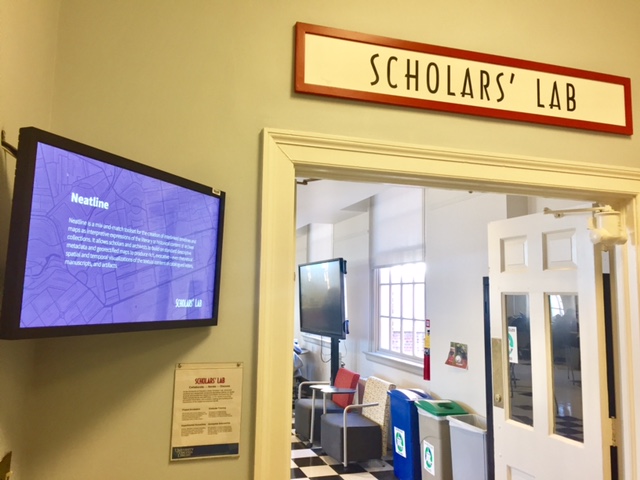
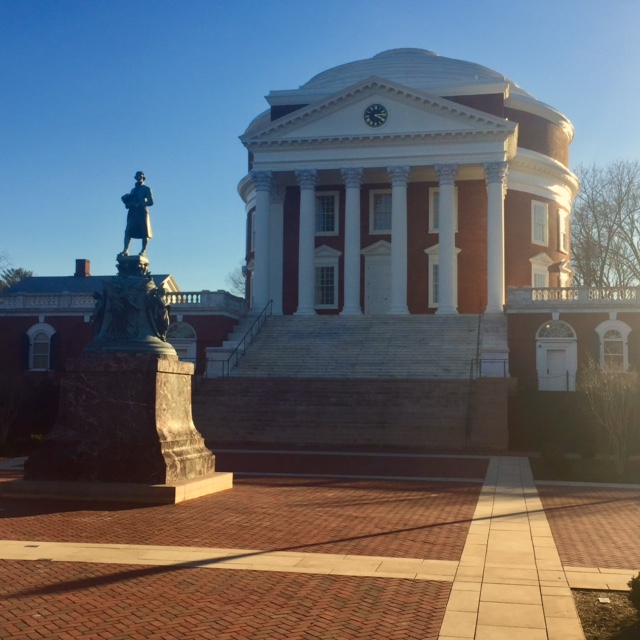
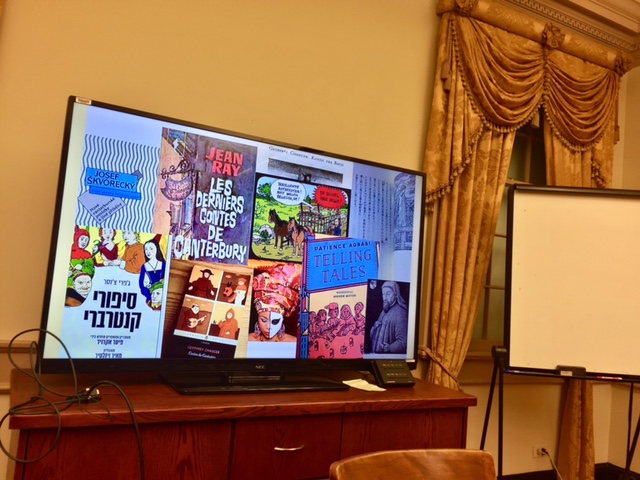
On 2 and 3 February 2017, Global Chaucers’ ambassadors, Jonathan Hsy and Candace Barrington, traveled to the University of Virginia in order to speak to the Scholars’ Lab and the Medieval/Renaissance Colloquium about “Digital Hospitality” on Thursday afternoon, and to lead a roundtable on “Linguistic and Cultural Hospitality” with the Medieval/Renaissance Colloquium on Friday morning. In addition to the two events’ lively Q&As, we enjoyed ample opportunities to enjoy rich conversations with UVa faculty and graduate students before and after the scheduled sessions. Their probing questions and thoughtful suggestions helped us think about some of the next steps available to Global Chaucers. All in all, the two days became less about what we shared with our UVa colleagues and more about the unusual luxury of measuring Global Chaucers’ development thus far and assessing the directions it could take in the future.
When we started this blog in September 2012, we didn’t really know what direction our fledgling project would take. We were uncertain about what sort of global Chaucers were out there—and we certainly didn’t know how we could respond to what we did find. And though we had a website with a list of the translations and appropriations we had tracked down, it wasn’t entirely clear to us that we had a Digital Humanities project.
While we still aren’t certain the directions Global Chaucers will take, we now realize we have a viable DH project. Beyond the ongoing blog reports and the initial catalog of print texts, our website takes advantage of its ability to provide links to graphic novels, poetic performances, translators’ readings, spoken word and standup, and non-spoken languages (such as ASL). Our principles of digital hospitality and openness require, however, that along with embracing the inherent advantages of a digital archive we must also acknowledge and address the unanticipated challenges figured by two curious examples we’ve encountered.
In April 2015, we were pleased to discover a tweet by Sarah Bickley with her exciting, playful, and brilliant emoji translation of the first 20 lines of the General Prologue. We reached out to her, asking her permission to post on the site and added this screenshot with the link. This act of emoji translation—which went viral on twitter over the next week or so—invites such fascinating questions as “are these lines legible to anyone who isn’t already familiar with the GP?” In any case, our archiving of this tweet through a blog post demonstrates one downside to digital communication: its transience. Since the posting of this link, Sarah has since closed her twitter account, and the snapshot that now remains on the blog is a ghost of its former viral life.
On the first Whan That Aprille Day in 2014 (encouraged by the Chaucer Tweeter, LeVostreC), we posted the opening lines in twelve different languages. Some of the non-Roman scripts did not display well, so we took screenshots and posted them online. What we have discovered, though, is that the pleasure of encountering the text in an array of unfamiliar scripts and tongues is not accessible to all. One of our collaborators is blind, and she uses a screen reader to access online material; that device cannot read non-English texts or scripts. Moreover, image files without alt-text are completely inaccessible (there might as well be nothing there). The screen-grabbed emoji poem is likewise completely inaccessible for her at present. Likewise, any audiovisual materials hosted on our site are currently inaccessible to Deaf or hard of hearing visitors unless we embed captions. What might seem like digital openness to many can end up excluding some.
Just as the principle of digital hospitality requires us to rethink our digital presence, the principles of linguistic and cultural hospitality also require us to reconsider how we imagine Global Chaucers and its collaborators. We began thinking that we would be creating an archive of data and texts that we would then analyze and disseminate. Although we remain the project’s primary ambassadors, the active interest and participation of other scholars, translators, and enthusiasts means that we shouldn’t resist participants ready to take Global Chaucers in new directions. Not only does information want to be free, so do the voices and data assembled under the Global Chaucers rubric. We hope that the project becomes multi-faceted, with some of its aspect thriving without our direct involvement.
So what are some of the new directions that our UVa conversations helped reveal?
It’s time to rethink our initial parameters of “post-1945 translations and appropriations of The Canterbury Tales.” Our catalog now includes translations of and engagements with Troilus and Criseyde, The Parlement of Fowles, and Chaucerian lyrics; and the catalog spans works from as early as the sixteenth century.
Our catalog is diverse enough to justify bringing in colleagues with coding expertise, so that we can creating a database coding our collected information about the various translations—languages, translators, tales, dates, and source texts, for instance. That database will then be used to do more outwardly visible work, such as classroom-friendly mapping projects.
We need to determine the best way to archive the various forms of graphic, visual, and audiovisual media, including the possibility of a new infrastructure for such material. If Global Chaucers is to encourage an inclusive dialogue about Chaucer as well as more to provide more routes of access that allow us to discuss problematic aspects of his verse, then we need better ways to archive and present information.
We need to consider if its desirable to switch the Global Chaucers site into a maker space rather than a user space. If we decide to move in that direction, then we will need help to make the change.
Although we are not certain about the shape Global Chaucers will take, we are confident it will adhere to its initial values of digital, linguistic, and cultural hospitality despite the challenges those values might pose. For these reasons, we were gratified to learn that our UVa colleagues shared not only our enthusiasm for Chaucer’s global reception but also our commitment to creating a global community.
Thank you Justin Greenlee, DeVan Ard, Zach Stone, Bruce Holsinger, Elizabeth Fowler, Anna Brickhouse, and the Scholars’ Lab staff for your gracious hospitality and for the opportunities to share our work and to learn from you.
At the 2017 Modern Language Conference, I was part of a “Campus Chaucer” round table sponsored by the Chaucer forum. Thinking in terms of how current political debates are echoed in Chaucer’s The Canterbury Tales or erupt in our classrooms, Lisa Cooper (University of Wisconsin, Madison) spoke on the value of labor, Liz Scala (University of Texas, Austin) spoke on expressing diverse opinions on a campus with guns, and Nicole Sidhu (East Carolina University) spoke on sexual assault and trigger warnings.
Below is the text of my talk on English-only politics. It includes links to my referenced sources as well as to the assignments I discuss.
During the Republican presidential primaries, the eventual nominee and president-elect announced, “This is a country where we speak English, not Spanish.” Based on that statement and the subsequent rhetoric of the 2016 presidential campaign, I anticipate that right-wing champions will add to their arsenal a familiar shibboleth, English-only policies. Used to support nativist causes in the United States, English-only statements are already a standard part of anti-immigrant stances. For instance, this past Wednesday evening, NPR’s story about efforts to resettle Syrian refuges in Toledo, Ohio, included this impromptu statement from John Johnstone, a Navy veteran:
“If you want to come here and turn the United States into Syria, I’m against that.
“If you want to come here and speak English, you want to assimilate, you want to have a pizza, you want to have a beer, you want to eat a chicken wing, I’m all for it.”
For Johnstone, Americanness is marked by a constellation of recognizable behaviors—what one eats, what one wears, what one drinks—and at the center, holding these behaviors together is what one speaks: English. In this line of thinking, speaking English marks a newcomer’s willingness to leave old habits behind and to adopt new ways, even ways antithetical to religious beliefs protected by the first amendment. Unless English is spoken, a newcomer has not made the necessary sacrifices to be an American. According to English-only logic, what separates those worthy of being in the United States from those who are not worthy is the willingness to speak English, a willingness from which the ability to speak English is assumed to flow naturally.
The state of Connecticut where I teach, has demonstrated little previous support for English-only policies. From what I can tell, a lone proponent’s legislative efforts resulted in only one hearing at the Connecticut Assembly, and that was back in the 1990s. While the much of the country turned red in the past two decades, Connecticut has largely stuck to its progressive values. Conservative voices have been largely muted, and right-wing values have been kept under wraps. With the prospect of a new administration in Washington and a more closely divided state legislature, however, I’m seeing a shift in tone. Conservative voices have grown bolder, and more brazen right-wing bumper stickers (my primary index for comparative levels of discontent among the general populace driving up and down I91) have appeared on the backsides of vehicles in the seven weeks since the election. Now that I’m seeing increased numbers of “Connecticut Citizens Defense League” decals in rear windows—a more aggressive statement than it might initially appear when you remember the 2012 mass shootings in Newtown, Connecticut—and the more overtly menacing “Come and Take It!” bumper stickers on the back of pickups, I wonder if I’ll start to see more “If you live in America SPEAK ENGLISH” on my daily commute.
Although English-only policies in Connecticut might have seemed far-fetched the last time I taught Chaucer’s The Canterbury Tales, those policies and the politics informing them warrant my courses’ attention this spring. And if this is true in Connecticut, it’s probably true in your state, too.
What is a Chaucerian to do?
First, no matter where we teach, we need to be aware of the ways Chaucer and other medieval English authors can be co-opted by nativist politics, a point Sierra Lomuto makes in her December posting, “White Nationalism and the Ethics of Medieval Studies” for the “In the Middle” blog. Rooted in nineteenth-century nationalism and nationalist medievalism, white nationalism easily slides into unfounded notions of a pure English tongue worthy of its eventual global domination. According to this narrative, American English is the undefiled descendant of a language that sprang forth from the British Isles before dominating the world with its linguistic flexibility and semantic dexterity, absorbing bits of other languages without being tainted by the process. As we saw in the nineteenth and early-twentieth centuries, Chaucer and his work can be brought into the narrative when he is identified as the well-spring of a pure English language and the “father” of English letters.
Of course, with few exceptions, students enter our classes on The Canterbury Tales with minimal knowledge of Chaucer or the history of English. And most likely they are not burdened with false information co-opted by nativist politics about the ways medieval languages and literature embody a pure Anglo-Saxon ethos. Nevertheless, most have an opinion about English-only policies, an opinion often informed by their own relation to other languages. Although many of my students are within a generation or two of their families’ having immigrated to the United States, it has never occurred to me to discuss English-only policies or their opinions on the subject. In these changed circumstances, however, I plan to initiate a discussion early in the term and to approach the topic of English-only politics in two ways, each using the lens of translation.
The first approach works against the notion that there is or ever has been a stable English linguistic tradition, untouched by other languages, by emphasizing Chaucer as a translator whose works appropriate and embed multiple literary and linguistic practices. Using etymological exercises, we will also explore the essential plurilinguistic nature of English and disabuse ourselves of any sense of linguistic purity and homogeneity even in earlier, pre-global forms of English. Inspired by an assignment shared by Melissa Ridley-Elmes, I also plan to ask students to track particular French terms—such as curteisie, sovereynetee, vileynye, subtil, aventure, gentillesse, entente, and sondry—for their shifting semantic properties not only across the Tales but also through the centuries from medieval French to present-day English. These two exercises will help students grasp the benefits other languages have brought to English as well as the ways English speakers reshape those stolen terms.
My second approach takes an entirely different tack. Developed in collaboration with other faculty teaching Chaucer’s The Canterbury Tales at universities with multilingual students, this approach centers on an exercise highlighting the bi-lingual / bi-literate expertise of students by using non-Anglophone translations of the Tales. Rather than seeing these translations as cribs for unsteady readers of Middle English, the exercise highlights the ways translations can reveal less apparent aspects of the Middle English text. Moreover, bringing translations into my classroom allows students to explore (for example) the difference between a Christian pilgrimage and a Muslim haj in the Arabic text, the discomfort with sexuality in the Korean translation, the celebration of sexuality in the Brazilian translation, and the avoidance of religion in the Chinese translations.
Even monolingual students are fascinated by the ways the translations help them see the Middle English text from a new perspective. This fascination is especially pertinent when translated words embody ideas that seem timeless and unchanging to the students. Although they may have never taken a pilgrimage, they assume all pilgrimages have basically the same purposes and make similar demands. When a Turkish translation embeds sexual attitudes similar to the students’ own, they are more open to hearing what it says about Muslim dietary practices. Most significantly, the translations help students see where the tale’s perspectives do not align their own: that the anti-Semitism in ThePrioress’s Tale might be deeply engrained, that the misogyny in The Merchant’s Tale might not be an eccentricity, or that the piety in The Second Nun’s Tale might not be a medieval aberration.
Bringing The Canterbury Tales into contact with other languages—either through the etymology exercises or the non-Anglophone translations—provides students with the necessary knowledge to question the premises underlying English-only politics. Although I’ll probably reveal my thoughts on those ill-begotten policies, the class’s careful attention to Chaucer’s language and its engagement with languages past and present, I suspect, will do the work for me.
This week’s Penn Humanities seminar stepped away from the usual format (a presentation by a forum fellow followed by a response from another fellow) and paused for a bit to consider two important texts for translation theory: Walter Benjamin’s “The Task of the Translator” and Bruno Latour’s “How to Resume the Task of Tracing Associations.” Elsewhere, I’ve reflected on the ways the Global Chaucers project realizes some of the claims of Benjamin’s essay, the most important being the way a translation “must lovingly and in detail incorporate the original’s way of meaning, thus making both the original and the translation recognizable as fragments of a greater language, just as fragments are part of a vessel.”[1] Extending this concept (without necessarily buying into his transcendental inclinations), we can see how multiple translations might provide more fragments of the vessel, and we can expect that studying these multiple translations together will provide a more complex sense of the original than could the study of a single translation.
Latour, too, is interested in making connections among fragments. The associations he looks for would initially seem to be based on similarities; however, as his extensive citations of Gabriel Tarde suggest, the more significant associations are marked by differences.[2] From a sociological perspective, this difference means that in order to make those associations we must translate. Translation, in one form or another, therefore saturates our interactions and structures our relationships. When we begin to examine multiple translations of The Canterbury Tales, a likely place to start will be at moments of difference, those places where translators found different solutions to a linguistic dilemma. These points of apparent incommensurability guide us to places where meaning (in both Chaucer’s text and in the translation) threatens (or perhaps even does) fall apart; the translation, then shows us one possible way to re-associate the terms and thereby create meaning. When the translations are separated by significant temporal lengths or geographical spaces, the results can be an especially rich set of associations allowing us also to observe how meanings shift across time and space.
Latour also reassures that there is no urgency, no need to bring all the translations together in one grand Chaucerian vessel. Instead, the sociologist’s networks of association allow us to consider the numerous combinations and unexpected hybrids, thereby allowing us to trace connections that make visible what is otherwise hidden to the monolingual reader.
My brief reflections touch only tangentially today’s fascinating conversation that explored the associations animating these two essays.
[1] Walter Benjamin, “The Task of the Translator,” trans. Harry Zohn, in Selected Writings, vol 1, ed. Marcus Bullock and Michael W. Jennings (Harvard University Press, 1997), 260.
[2] Bruno Latour, Reassembling the Social: An Introduction to Actor-Network-Theory (Oxford University Press, 2005), 14-16.


 since the election. Now that I’m seeing increased numbers of “Connecticut Citizens Defense League” decals in rear windows—a more aggressive statement than it might initially appear when you remember the
  menacing “Come and Take It!” bumper stickers on the back of pickups, I wonder if I’ll start to see more “If you live in America SPEAK ENGLISH” on my daily commute.
 and paused for a bit to consider two important texts for translation theory: Walter Benjamin’s “The Task of the Translator” and Bruno Latour’s “How to Resume the Task of Tracing Associations.” Elsewhere, I’ve reflected on the ways the Global Chaucers project realizes some of the claims of Benjamin’s essay, the most important being the way a translation “must lovingly and in detail incorporate the original’s way of meaning, thus making both the original and the translation recognizable as fragments of a greater language, just as fragments are part of a vessel.”