Newsflash from Rome: Chaucer in Polish

We were very pleased to hear from Laurence Warner that the Medieval Symposium at last week’s International Association of University Professors of English (IAUPE) conference in Rome included a presentation by Professor Ewa Kujawska-Lis on “Canterbury Tales in Polish.” Of course, we contacted Ewa right away. She kindly provided précis of her paper for us to share with the Global Chaucers community. We look forward to learning more from her as she expands our knowledge of Chaucer’s long and deep presence in Polish translations and scholarship.

by Ewa Kujawska-Lis, Director of the Institute of Literary Studies, Faculty of Humanities,
University of Warmia and Mazury in Olsztyn, Poland

In Poland, Chaucer’s artistry was first noticed by two outstanding literary figures (poets, writers, and journalists): Ignacy Krasicki (1735-1801) and Adam Mickiewicz (1798-1855). Well acquainted with European literature, they offered appreciative comments on the English poet almost a century before any Polish translation was available. Readers needed to wait until 1907 to get the feel of Chaucer themselves. This is when Jan Kasprowicz (1860-1926), a poet, playwright, critic, and translator, included fragments of The General Prologue and a large section of The Friar’s Tale in his anthology Poeci angielscy (English Poets). The translation, consisting of about 20 pages, served as an introduction of Chaucer to the Polish literary system and was based on the edition of The Canterbury Tales by Thomas Tyrwhitt (1775-78) and a German translation by Wilhelm Hertzberg (1866).

Half a century later, in 1956 Przemyslaw Mroczkowski published his monumental study Opowieści kanterberyjskie na tle epoki (The Canterbury Tales against the backdrop of the epoch), originally written in 1951, which was a milestone in introducing Chaucer to Polish scholars in the vein of what would be in the future termed cultural poetics. Subsequently, in 1988, he also translated The Knight’s Tale.

This served as a complement to the first more extensive translation of The Canterbury Tales into Polish that was created by Helena Pręczkowska and published in 1963 (Wrocław: Zakład Narodowy Im. Ossolińskich, 1963; reprinted in 1978 and 1987) (image at left). This volume included The General Prologue and eleven Tales selected by Witold Chwalewik, based on his rather arbitrary decision as to which stories should be translated.

Finally, the complete translation of The Canterbury Tales was published in 2022 as the second volume of a non-commercial series Bibliotheca Translata by the publishing house Biblioteka Śląska (image at top). The translation was done by Jarek Zawadzki, a translator of literature from English and Chinese, based on Walter W. Skeat’s edition of 1894, with illustrations by Maciej Sieńczyk, a graphic artist, illustrator, comic book creator.

Chaucer in Japan (two conferences!)

[CAPTION: obligatory photograph of Hiroshima Castle as it looks today with blooming cherry blossoms in the foreground.]

We’re very happy to help spread the word about these two upcoming conferences in Hiroshima, Japan; thanks to Global Chaucers blog contributor Jonathan Fruoco for sending along this information!

The 2023 Hiroshima International Conference, 7 August 2023; co-organized by Yoshiyuki Nakao and Jonathan Fruoco: “In sondry ages and sondry londes: Global Chaucer in the XXIst Century,” with invited lectures by Stephanie Trigg and Anthony Bale. Click on images below to see enlarged versions of the program.

From Jonathan Fruoco:

We may have been living in the XXIst century for two decades but the challenges of keeping medieval literature relevant for another hundred years have yet to be addressed. In this conference, we thus offer to consider what academics can do to continue transmitting a universal linguistic and literary inheritance that has survived since the Middle Ages.

The fact that this conference will be held in Japan is proof enough of the universality of the cultural relevance of medieval literature in a culturally diverse environment. Yet, in large parts of the world, medieval studies have started to disappear from universities, showing in a way our failure to keep our inheritance alive. Such is, for instance, the case in France where the works of Geoffrey Chaucer, the most French of English poets, have almost disappeared from memories.

During this conference, we accordingly invite colleagues from Asia to reflect on how we may encourage a new generation of readers and scholars to support medieval studies in a non-Anglophone environment. The translation and re-translation of the works of medieval poets might, for instance, be a way to reintroduce poets to a new audience — see for instance the recent translation of the Canterbury Tales in Japanese by a team of scholars, or the work accomplished by non-Anglophone translators throughout the world. This would lead us to question the difficulties (linguistic, but not only) of translating/adapting Middle English in different languages, and of finding audiences.

The 63rd Summer Seminar of the English Research Association in Hiroshima, 8 August 2023; Jonathan Fruoco and Anthony Bale are among the invited speakers.

New Chaucer Society 2022 Congress: Wrap Up

by Candace Barrington

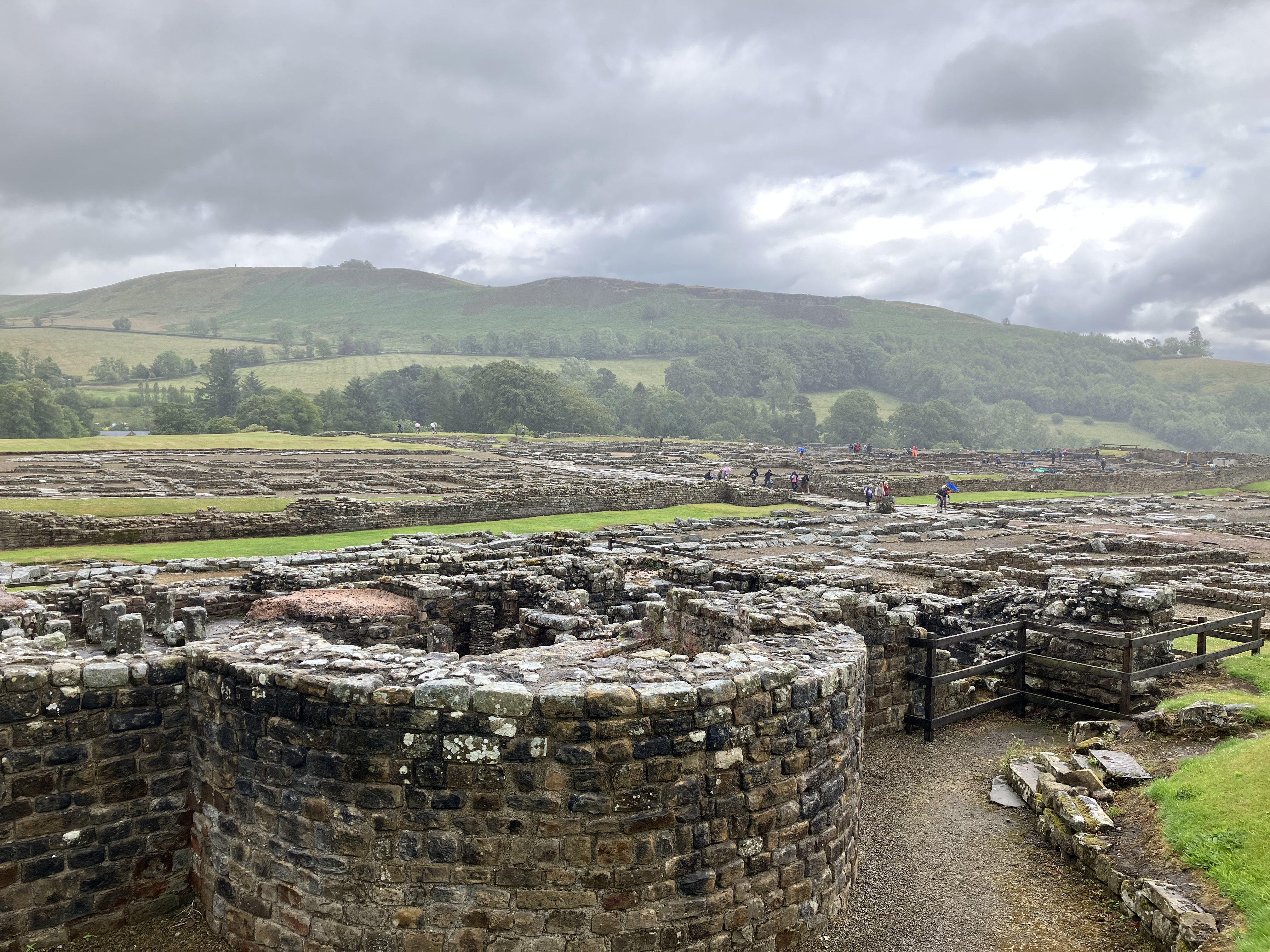
Vindolanda: destination for one of three NCS excursions and excellent reminder of the many peoples involved in the Roman colonial project.

The 2022 NCS Congress featured an inspiring number of sessions with a global or multi-cultural perspective. And a good number of presenters were from non-Anglophone backgrounds, though many were unable to attend in person because of visa, funding, and pandemic restrictions.

Because there’s still a chance for you to view the Congress sessions and uploaded presentations–here’s a quick list of the papers/sessions dealing with Chaucer’s reception, global and otherwise, that I attended.

Papers

  • Jacqueline Burek, “Translating Troilus: The Welsh Troelus a Chresyd
  • Louise D’Arcens, “The Kangaroo Kelmscott: Chaucer’s Sydney Afterlife and Australian Deep Time”
  • Aistė Kiltinavičiūtė, “Reimagining the Dream Poet: Edward Burne-Jones’s Dantean Chaucer”
  • Usha Vishnuvajjala, “Feminist Medievalisms and Chaucer in Jane Austen Fanfiction”
  • Wajid Ayed, “Chaucer in Tunisia: 50 years”
  • Raúl Ariza-Barile “From Southwark to the Citee of Mexico: Producing the First Ever Mexican Translation of The Canterbury Tales”
  • Lian Zhang, “Translation as Remembering: Canterbury Tales in Chinese”
  • Yoshiyuki Nakao, “How to Translate Chaucer’s Multiple Subjectivities into Japanese: Ambiguities in His Speech Representation”
  • Amy Goodwin, “Chaucer in the New York Times”

  • Jonathan Hsy, “Racial Displacements: Chaucerian Poets of Color and Critical Refugee Studies”
  • Jamie Taylor, “Indigenous Studies and a Global Middle Ages”
  • Candace Barrington, “Comparative Translation: Possibilities and Limitations”
  • Jonathan Fruoco, “Is there an Embargo on Chaucer in France?”
  • Marion Turner, “The Wife of Bath’s European Lives”

Plenary Sessions

  • “Where Medieval Studies Joins Up,” a plenary conversation chaired by Jonathan Hsy featuring
    • Anthony Vahni Capildeo
    • Wallace Cleaves
    • Ananya Jahanara Kabir
  • The Refugee Tales, with Patience Agbabi
  • The Polyglot Miller’s Tale Reading

If you were a registered participant at the Congress, you can view the sessions and individual papers.

  • Go to ncs2020.net
  • Click on Attendee Hub and log in just as you did during the Congress
  • Select “All Sessions” on Schedule pull-down menu (upper)
  • Search for the speaker’s name, then follow the links to replay either the session or watch the uploaded presentation.

These links will remain available until mid-October.

2022 New Chaucer Society Congress, Durham, UK: Polyglot Reading of The Miller’s Tale

by Candace Barrington

In a happy reprise of the spontaneous (but very jolly) Polyglot Reading of The Miller’s Tale at the 2014 NCS Congress in Reykjavik, 14 Global Chaucerians gathered to read the tale in 9 languages (in addition to Middle English).

  • 1.3109-3135, Middle English, Candace Barrington and Jonathan Hsy
  • 1.3136-3166, Welsh, Jacqueline Burek
  • 1.3167-3220, Spanish, Amanda Gerber
  • 1.3221-3287, Lithuanian, Aistė Kiltinavičiūtė
  • 1.3288-3338, 19c French, Juliette Vuille
  • 1.3339-3398, German, Lucy Fleming
  • 1.3399-3467, Arabic, Wajih Ayed
  • 1.3468-3525, Italian, Sarah McNamer
  • 1.3526-3588, Hebrew, Noa Nikolsky
  • 1.3589-3656, German, Lucy Fleming
  • 1.3657-3726, French, Jonathan Fruoco
  • 1.3727-3785, Korean, Mariah Min
  • 1.3786-3854, Italian, David Wallace

Some special highlights include

  • the premier of Jonathan Fruoco’s new French prose translation of the tale,
  • the first ever translation into Welsh thanks to the intrepid Jacqueline Burek,
  • the introduction of Korean slang and dialect into Mariah Min’s reading,
  • Lithuanian (need we say more?),
  • a sequenced chorus of Alisoun’s “Tehee” (3740), and
  • a recording, now streaming and available through mid-October to those who registered for the congress (either in person on online).

And, of course, lots of laughter.

In addition to thanking our fabulous readers (both new ones and repeat participants) for their full-hearted participation, we owe our deep gratitude to

  • Mary Flannery for initially inviting us to resume the reading at the soon-to-be postponed 2020 Congress,
  • Julie Orlemanski and Phil Smith for juggling schedules to ensured the reading happened in 2022,
  • Patience Agbabi and other members of our audience for supporting us with their presence and laughter,
  • Annette Kern-Stachler, Lian Zhang, Raúl Ariza-Barile kept away by the complications of pandemic-era travel, and
  • Durham University’s excellent tech staff who smoothly orchestrated the recording and transmission of the event.

If you were a registered participant at the Congress, you can view the streaming broadcast of the reading.

  • Go to ncs2020.net
  • Click on Attendee Hub and log in just as you did during the Congress
  • Select “All Sessions” on Schedule pull-down menu (upper)
  • Search “polyglot,” then click on “Polyglot Miller’s Tale Reading”
  • Click on “replay”
  • After lots of preliminaries, the actual reading begins at 17 minutes and ends at. 59.30

Plans are already brewing for 2024. Let us know if you’re interested in participating at globalchaucers at gmail dot com.

The Polyglot Miller’s Tale Returns!

2014 Polyglot Reading, NCS Congress, Reykjavik, Iceland

It’s that time again! We’re rounding up participants for the “Polyglot Miller’s Tale Reading” at the 2022 NCS Congress in Durham, UK.

After some shuffling to accommodate more participants, we’re happy to announce that the reading is now scheduled for Wednesday, 13 July, 7:30p to 8:30p.

Currently, we have volunteers to read in French, Italian, German, Polish, Arabic, Hebrew, Dutch, and (be still my heart!) Lithuanian. We’d still love to add more languages, such as Mandarin, Japanese, Korean, Hindi, Malayalam, Frisian, Romanian, Norwegian, Serbian, Icelandic, Spanish, Turkish, Afrikaans, Portuguese, Finnish, Estonian, Greek, Russian, Ewe, Farsi, Czech, Taiwainese, and any other language into which the tale has been translated. (For help finding a translation, contact us or refer to our list of translations; if you know of others, please let us know.)

Depending on the total number of volunteers, participants will be asked to read around 50-60 lines apiece.

If you’d like to be part of the fun, please email us (GlobalChaucers at gmail dot com) with this info:

  1. which language(s) you’d like to read in;
  2. if you possess a copy of The Miller’s Tale in that language (if you don’t, we likely can send a copy to you); and
  3. if you consent to being recorded (both audio/video).

In mid-May, we will send your line assignments (and a copy of your lines, if requested).

We appreciate your patience as we pull together what promises to be a lively event.  

The Chaucer Studio and Global Chaucers will collaborate on new recordings of The Canterbury Tales in translation

by Shannon Prevost

https://www.wga.hu/html_m/zgothic/miniatur/1351-400/3other/10_1351.html

The Chaucer Studio and Global Chaucers will be working together in the near future to provide and create recordings of The Canterbury Tales in different translations. We learned from Michael Calabrese of California State University that “the idea of translating Chaucer in different languages for global access is an inherent part of what we would like to do.” The co-directors of the studio are pleased to collaborate with Global Chaucers to provide more readings of Chaucer’s works in translation.

The first planned recording will be in Spanish, read by Christina Gomez, executive director of the studio.

In the future we will work with interested parties to record either already existing translations or new translations. Global Chaucers and the Chaucer Studio will work together to provide global distribution and access. We are currently soliciting participants who’d like to translate and/or record with us.

The new set of co-directors at Chaucer Studio are:

  • Michael Calabrese (California State University, Los Angeles)
  • Tom Burton (University of Adelaide)
  • Regula Meyer Evitt (Colorado College)
  • Cathy Hume (University of Bristol)
  • Joseph Parry (Brigham Young University)
  • Christina Gomez (California State University, Los Angeles)

COMMode: Canonicity, Obscenity, and the Making of Modern Chaucer (1700-2020)

by Candace Barrington

I was delighted to learn about a fairly recent project headed by Mary Flannery, Amy Brown, and Kristen Haas Curtis. Its name, COMMode, wittily points to the scatological humor many readers associate with Chaucer and his Tales. The project investigates and queries the relationship between Chaucer’s modern reception and his obscenity, a set of important questions that have fascinated me for a couple of decades. Moreover, they are reaching beyond the usual suspects. Already the site’s blog has featured descriptions of two global Chaucers: Shing Yin Khor’s oracle cards (link and images above) and Chaucer in 19th-century Australia.

A new Japanese translation of The Canterbury Tales

by Candace Barrington

My copy of the beautifully executed translation of Chaucer’s The Canterbury Tales into Japanese arrived today thanks to Koichi Kano. In addition to new translations of all the tales, the volume includes Ellesmere images of the pilgrims, extensive notes, and an ample bibliography.

I look forward to learning more about the translations, their translators, and their translation strategies very soon.

Online launch party!

In celebration of the publication of the first volume of a new edition by Classiques Garnier of Chaucer’s Complete Works translated into French by the general editor and translator Jonathan Fruoco, you are invited to an online launch party.

Details of the edition: https://classiques-garnier.com/chaucer-geoffrey-le-livre-de-la-duchesse-et-autres-textes-tome-i-oeuvres-completes.html

The recorded launch party remains available on YouTube.

Friday, September 24, 2021

1:00 PM – 2:00 PM EDT

Alisoun Sings!

Caroline Bergvall continues her exciting and longstanding engagement with Chaucer’s Middle English and tales with her latest publications, Alisoun Sings.

If, like us, you’re a fan of Bergvall’s work, you’ll also want to take note of her project, “Conference of the Birds (Attar).” Though the title might ring a bell, this collaborative project is based on a poem by the medieval Persian poet, Attar of Nishapur. For more on the resonances between Chaucer’s ouevre and Attar’s Mantiq-Ut-Tayr, see Alireza Mahdipour’s article, “The Translator Writes Back,” in Chaucer’s Global Compaignye: Reading The Canterbury Tales in Translation, special issue of the Global Circulation Project at Literatuare Compass 15.6 (2018).