Taking a cue from Chaucer’s band of pilgrims, participants in Gatwick Detainees Welfare Group’s Refugee Tales Walk are midway through their 9-day walk on the North Downs Way from Dover to Crawley via Canterbury. Along the way, writers, musicians and other artists will share tales inspired by the migrants and refugees: The General Prologue, The Migrant’s Tale, The Chaplain’s Tale, The Unaccompanied Minor’s Tale, The Arriver’s Tale, The Lorry Driver’s Tale, The Visitor’s Tale, The Detainee’s Tale, The Interpreter’s Tale, The Appellant’s Tale, The Counsellor’s Tale, The Dependent’s Tale, The Friend’s Tale, The Deportee’s Tale, The Lawyer’s Tale, The Refuge’s Tale, The Ex-Detainee’s Tale, and a Reprise of the Tales.
Photos and journal entries provide the rest of us an opportunity to share in the events.
Thanks to Dan Kline for alerting us to this deeply moving project.
View from the moderator’s table. “Trans-Medievalisms” session at BABEL in UCSB, October 2014.
It’s been about a month since the Third Biennal Meeting of the BABEL Working Group at the University of California at Santa Barbara. Candace Barrington and I (on behalf of the Global Chaucers project) organized a session entitled “Trans-Medievalisms.” This session considered what happens when “the Middle Ages” (whatever we mean by that term!) traverses different cultures, languages, material forms, and media. The call for proposals and/or manifesto (previously posted on this blog) was as follows:
What happens to the Western Middle Ages when it crosses into diverse, concurrent times, languages, and cultures? How does “medievalism” take shape in multiple spaces across the planet—including cultural habitats where the Western Middle Ages are no longer the “‘zero point’ of orientation” (to reroute a phrase from Sara Ahmed’s Queer Phenomenology)? What cultural work do “the Middle Ages” perform as they infuse modern-day modes of global media and cultural production—textual, visual, musical, performative, cinematic? Our session is inspired by our work on the Global Chaucers project, a utopian scholarly endeavor that seeks to gather, back-translate, and analyze all non-English translations and adaptations of Chaucer’s work. Our scheming with scholars around the world has so far revealed Chaucerian adaptations in places as far-flung and interconnected as Latin America (Argentina, Bolivia), East Asia (China, Japan, Korea), Europe (Denmark, Flanders, Spain, Hungary), the Middle East (Israel, Iran), and Africa (Nigeria, South Africa), as well as works in re/invented languages (Esperanto, Neo-Latin).
For this session we aim to gather participants working on Chaucerian adaptation in non-English contexts or any aspect of medieval appropriation in “global” contemporary culture (however conceived). How might plurilingual, transoceanic, and intercultural orientations provoke new modes of engaging with the past? How can we create a dynamic, multi-site community of cross-temporal scholars and enthusiasts, a fluid collective that thrives across disciplines and borders? We welcome non-medievalists, amateurs, and enthusiasts, including creative work by poets, playwrights, musicians, and/or interpretive dancers. We highly encourage collaborative submissions.
The session at UCSB resulted in four strikingly divergent yet enticingly intertwining presentations.
Raúl Ariza-Barile: Chaucer’s Spanish Accent: Impossible Poetry? Raúl’s paper offered a brief background of Chaucerian translation into Spanish, suggesting (among other things) how a careful consideration of Latin American contexts might shift our conversations about the aims and practices of modern translators; the presentation ended with a debut performance of his own translation of the opening lines of Chaucer’s General Prologue into rhymed Spanish verse.
Shyama Rajendran: The Impossibility of Locating The Ramayana. Shyama’s presentation traced the movement of the ancient epic Ramayana across many cultural traditions and performance contexts beyond South Asia, attending to a plurality of reception histories across time and space; she ended with a careful consideration of the political implications of the Ramayana’s narrow appropriation for the purposes of Hindu nationalism in contemporary India.
Carol Robinson: Expressing Loathly Ladies—Explicitly Noncompliant. In this presentation, Carol featured the work of two of her former students who created a collaborative video adaptation of the Wife of Bath. Each student had recorded a dramatic monologue: one performance used ASL to engage with Deaf culture, relating the episode when the Wife is rendered deaf; a “political dramatization” by a queer student (in drag) incorporated contemporary debates about polygamy and marriage.
Elaine Treharne: TEXT Technological Transformations: the Inexactitude of a Medieval Unreality. Elaine’s talk suggested the possibility of cross-cultural comparative analysis across seemingly disparate contexts including medieval Western and East Asian (Chinese) texts. Her reflections not only considered the rich materiality of textual production but also suggested its importance as artistic performance.
These presentations richly showcased the heterogeneity of cultural/artistic/linguistic materials that we might call “medieval” (thinking expansively beyond the contours of Latin-speaking Europe). At the same time, these perspectives collectively invited us to think more creatively about what new modes of medieval appropriation and comparative analysis actually might enact and enable.
Medievalism studies has certainly “arrived” in the academy and it is also clearly breaking down the boundaries between what lies within and outside of institutional and traditional academic structures. Global Chaucers is one such community among many, including other digital spaces like Medievally Speaking, and the Medieval Electronic Multimedia Organization (MEMO). We’re in a very exciting time for medievalism studies now and I hope that these networked communities will continue to thrive, grow, interconnect, and adapt.
A few weeks ago, Gail Ashton (who we have featured on this blog here and here) wrote a posting about Chaucer for the Bloomsbury Literary Studies blog. Ashton’s posting entitled “What the Dickens shall we do about Chaucer?” considers the “residual” presence of Chaucer in present-day British culture, and it ends with a revealing interview about Chaucer in the schools with former Welsh poet laureate Gwyneth Lewis and former Canterbury poet laureate Patience Agbabi.
Ashton’s posting also nicely ends with a plug for her forthcoming edited collection entitled Medieval Afterlives in Contemporary Culture(Bloomsbury, forthcoming 2015). Candace Barrington and I have a co-authored article entitled “Global Chaucers” in that collection–so stay tuned!
Snapshots from twitter: #WhanThatAprilleDay is trending! The day has just begun, but participants around the world have already posted videos; images of books, texts, and cakes; and tweets in languages ancient and modern.
Happy April!
In a recent posting, the famous Chaucer blogger and tweeter (@LeVostreGC) called for “Whan That Aprille Daye”: an occasion for people around the world to perform, tweet, or otherwise “celebrate al the langages that have come bifor, and alle their joyes and sorrowes and richesse.” The mission is to “remynde folk of the beautye and grete lovelinesse of studyinge the wordes of the past.”
Follow #WhanThatAprilleDay hashtag on twitter and social media to join in on the fun.
Some excellent items of note that have already appeared online:
Patience Agbabi (@PatienceAgbabi, mentioned a few times on this blog already) dons a medieval hoodie and recites the original Middle English General Prologue: a fitting prelude to her own remix forthcoming in just a few days in Telling Tales (Cannongate, 2014).
A few days ago, Stephanie Trigg shared this lovely video featuring the Middle English Reading Group at the University of Melbourne.
And this just in: Margaret Atwood (@MargaretAtwood) — inspired by a twitter-convo with the Chaucer blogger — posts an ancient Canadian ballad, a paean (what else?) to the wonders of April.
To join in this spirit of play, we are posting renditions of the opening lines of the General Prologue in diverse and sundry modern languages. Some are in prose, some in verse (free verse or rhyme). Those of you know the Middle English lines very well will certainly recognize many echoes in the Romance and Germanic languages.
Afrikaans (John Boje, 1989)
Wanneer Aprilmaand milde reënbuie bring
wat Maart se droogheid heeltemal deurdring
en elke aar met daardie vog bedek
wat kragtig bloome tot die lewe wek,
wanneer die westewind met soete geur
sy asem uitblaas op swak lote deur
die bos en hei, en die jong son gegaan
het tot de helfte van die Ram se baan,
en al die voëltjies opgeruimd uitsing
wat hele nagte met oë oop verbring
(dus prikkel die natuur hul handelswyse),
dang an mense graag op pelgrimsreise,
en swerwers hunker na die vreemde strande
van verre heiliges in vele lande.
Arabic (Majdī Wahbah Abd & Al-Ḥamīd Yūnis, 1983)
Catalan (Marià Manent, 1955)
Quan l’abril amb les pluges ve que alleuja
l’eixut del març, que penetrà a la rel,
i banya cada vena aquella limfa
que amb la seva virtut farà brotar la flor;
quan el Zèfir suau, amb la dolça alenada,
fa sortir en tots els boscos i brugueres
les tendres fulles, i el Sol, jove encara,
es troba a mig camí de Capricorni,
i ocells menuts fan una melodia
dormint tota la nit amb ulls oberts
(així els dóna coratge la Natura),
la gent ja té desig de romiatges
i busquen els romeus camins estranys
cap a temples famosos, per llunyedanes terres;
i assenyaladament, des dels confins de tots
els comtats d’Anglaterra, a Canterbury acuden
cercant el màrtir sant i beneït
que els donà ajut en temps de malatia.
Naar i April de friske Byger trænge
Ned i den tørre Muld paa mark og Enge
Og alle Rødder bade sig i Regn
Og skyde Blomster frem som Livsenstegn,
Naar Zefyr med sit friske, milde Pust
Hen over Krat og Hede lunt har sust.
French (Louis Kazamian, 1908, repr. 1942)
Quand Avril de ses averses douces
a percé la sécheresse de Mars jusqu’à la racine,
et baigné chaque veine de cette liqueur
par la vertu de qui est engendrée la fleur;
quand Zéphyr aussi de sa douce haleine
a ranimé dans chaque bocage et bruyère
les tendres pousses, et que le jeune soleil
a dans le Bélier parcouru sa demi-course;
et quand les petits oiseaux font mélodie,
qui dorment toute la nuit l’œil ouvert,
(tant Nature les aiguillonne dans leur cœur),
alors ont les gens désir d’aller en pèlerinage,
et les paumiersde gagner les rivages étrangers,
allant aux lointains sanctuaires, connus en divers pays;
et spécialement, du fond de tous les comtés
de l’Angleterre, vers Canterbury ils se dirigent,
pour chercher le saint et bienheureux martyr
qui leur a donné aide, quand ils étaient malades.
Frisian (Klaas Bruinsma, 2013)
Wannear’t april mei al syn swiete buien
oant yn ’e woartel poarre ’t maartske druien,
en alle ieren baaid’ yn sok in sop,
waans krêft it blomte wer ta libben rôp.
en bywannear’t ek Zéfirus wer aaide
mei swiete amm’ yn alle hôf en heide
de teare leaten, en de jonge sinne syn
heale baan rûn hat troch Aries hinne
en lytse fûgels melodijen meitsje
dy’t nachts wol sliepe, mar mei d’ eagen weitsje
(sa priket de natoer har yn ’e herten),
dan langet folk in beafeart yn te setten,
en pylgers sykje fiere, frjemde strannen
om hilligen bekend yn folle lannen;
om dan foaral út eltse krit’ en hernen
fan Ingelân nei Kenterboarch te tsjen en
de hill’ge, sill’ge martler op te sykjen,
dy’t harren holpen hat yn harren sykten.
German (Martin Lehnert, 1962)
Wenn milder Regen, den April uns schenkt,
Des Märzes Dürre bis zur Wurzel tränkt,
In alle Poren süßen Saft ergießt,
Durch dessen Wunderkraft die Blume sprießt;
Wenn, durch des Zephyrs süßen Hauch geweckt,
Sich Wald und Feld mit zartem Grün bedeckt;
Wenn in dem Widder halb den Lauf vollzogen,
Die junge Sonne hat am Himmelsbogen;
Wenn Melodieen kleine Vögel singen,
Die offnen Augs die ganze Nacht verbringen,
Weil sie Natur so übermüthig macht: –
Dann ist auf Wallfahrt Jedermann bedacht,
Und Pilger ziehn nach manchem fremden Strande
Zu fernen Heil’gen, die berühmt im Lande;
In England aber scheint von allen Enden
Nach Canterbury sich ihr Zug zu wenden,
Dem heil’gen Hülfespender aller Kranken,
Dem segensvollen Märtyrer zu danken.
Japanese (Masui Michio, 1995; repr. 2012)
Korean (Dongil Lee, 2007)
Brazilian Portuguese (José Francisco Botelho, 2013)
Quando o chuvoso abril em doce aragem
Desfez março e a secura da estiagem,
Banhando toda a terra no licor
Que encorpa o caule e redesperta a flor,
E Zéfiro, num sopro adociacado,
Reverdeceu os montes, bosques, prados,
E o jovem so, em seu trajeto antigo,
Já passou do Carneiro do Zodíaco,
E melodiam pássaros despertos,
Que à noite doormen de olhos bem abertos,
Conforme a Natureza determina
–É que o tempo chegou das romarias.
Turkish (Nazmi Ağıl, 1994)
Nisan that yağmurlarıyla gelip
Kırınca Marttan kalan kuraği ve delip
Toprağı köklere işleyince, kudretiyle
Çiçekler açtıran bereketli şerbetiyle
Yıkayınca en ince damarları,
Zephirus da dolaşarak kırları, bayırları
Soluyunca can katan ılık,
Tatlı nefesini körpecik
Filizlere, toy güneş yarı edince
Koç burcunkaki devrini, bütün gece
Uyumayıp börtü böcek
Şarkılar söyleyince (tabiat dürtükleyerek
Uyanık tutar onları) işte o dem,
Hacca gitmeye büyük bir özlem
Duyar insanlar.
P.S. Follow @JonathanHsy on twitter; he’ll tweeting and retweeting throughout the day!
Telling Tales, Patience Agbabi’s re-conception of the Canterbury pilgrimage aboard a bus, receives a saucy notice this week on the Times Literary Supplement‘s back page (28 March 2014). Calling her remix “an energetic compendium of familiar stories translated into the contemporary idiom of street slang and slam poetry,” the note closes with this with this interesting desiderata: “Now that Mr. Chaucer has his own blog (just try Googling it), we impatiently await his verdict.” LeVostreGC, it sounds as though the TLS wants to hear from you!
Logo for BABEL 2014 [all images from Joni Sternbach, Surfland]Here’s an upcoming event of interest to medievalists and non-medievalists alike: the 3rd Biennial Meeting of BABEL Working Group at UC Santa Barbara (16-18 October 2014). BABEL members include academics as well as poets, creative writers, scientists, philosophers, and others — and BABEL conferences are well-known for featuring a wide range of presentation styles and formats.
Candace and I are still accepting proposals for TRANS-MEDIEVALISMS!
The deadline is APRIL 1.
Trans-Medievalisms (Day 3)
Sponsor: Global Chaucers
Co-Organizers: Jonathan Hsy (George Washington University) + Candace Barrington (Central Connecticut State University)
Send brief proposals to < jhsy at gwu dot edu > or < BarringtonC at mail dot ccsu dot edu >
What happens to the Western Middle Ages when it crosses into diverse, concurrent times, languages, and cultures? How does “medievalism” take shape in multiple spaces across the planet—including cultural habitats where the Western Middle Ages are no longer the “‘zero point’ of orientation” (to reroute a phrase from Sara Ahmed’s Queer Phenomenology)? What cultural work do “the Middle Ages” perform as they infuse modern-day modes of global media and cultural production—textual, visual, musical, performative, cinematic? Our session is inspirited by our work on the “Global Chaucers” project, a utopian scholarly endeavor that seeks to gather, back-translate, and analyze all non-English translations and adaptations of Chaucer’s work. Our scheming with scholars around the world has so far revealed Chaucerian adaptations in places as far-flung and interconnected as Latin America (Bolivia), East Asia (China, Japan, Korea), Europe (Denmark, Flanders, Spain, Hungary), the Middle East (Israel, Iran), and Africa (Nigeria), as well as works in invented languages (Esperanto).
For this session we aim to gather together 5-10 presenters and/or performers. This session may include a few invited participants working on Chaucerian adaptation in non-English contexts (possibly with a focus on cultures from the Pacific Rim). We would like to invite additional proposals from people working on any aspect of medieval appropriation in “global” contemporary culture (however conceived). How might plurilingual, transoceanic, and intercultural orientations provoke new modes of engaging with the past? How can we create a dynamic, multi-site community of cross-temporal scholars and enthusiasts, a fluid collective that thrives across disciplines and borders? We welcome non-medievalists, amateurs, and enthusiasts, including creative work by poets, playwrights, musicians, and/or interpretive dancers. We highly encourage collaborative submissions.
Here’s an exciting event for members of the Global Chaucers community who are in the London area!
Gail Ashton is the editor (with Daniel Kline) of Medieval Afterives in Popular Culture(Palgrave, 2012), with further work on medievalism to appear in the near future (more on this soon!). She has just informed us of this very exciting event called Chaucer: Modern Echoes to be held on 10 April 2014, 7PM at Southwark Cathedral. Tickets cost £10 and can be purchased online; visit the event website to purchase tickets and for more details.
This event features readings of Chaucer’s work alongside presentations by two neo-Chaucerian superstars:
Patience Agbabi, poet and author of Telling Tales (Cannongate, April 2014), a mixed-form, multi-voiced verse retelling of The Canterbury Tales. [See this earlier blog posting about her work!]
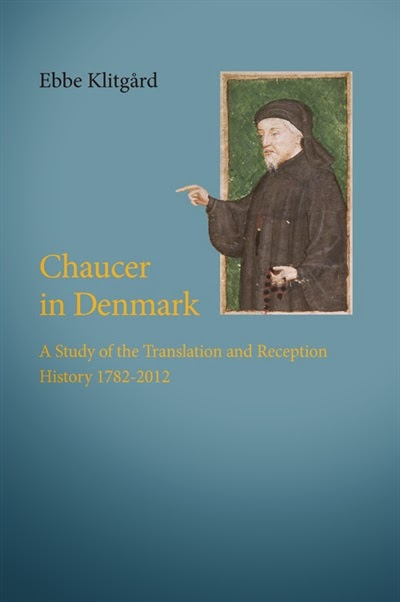
An early contributor to the Global Chaucers blog, Ebbe Klitgård, published his one-of-a-kind study, Chaucer in Denmark, in 2013. I had the opportunity to review it for Medievally Speaking. Without reprinting the entire review, I draw your attention to my final admonition:
With the commendable precedent for the study of Chaucer’s non-Anglophone reception now in place, Chaucerians and medievalists should encourage similar studies by our colleagues in predominately non-Anglophone universities and cultures. Such work enriches the study of Chaucer in important ways, yet its survival is not necessarily ensured. Because we know first-hand the difficulties of maintaining medievalist lines in English departments where we serve an English-speaking student population, we should be sympathetic to the even more precarious situations of Chaucerians housed in foreign-language departments. By attending to what they can tell us, ordering their books for our campus libraries, and by incorporating their research and translations into our own studies, we can support their important work and their careers. We have just begun to listen to them; it would be shameful to lose their voices now.
Ebbe will be at the NCS Congress in Reykjavik this summer and one of the panelists on the Global Chaucers Roundtable, where his topic will be “Chaucer in Denmark since 1945: A Discussion of Some Adaptations and Translations, with a Focus on Illustrations”
We have great news for Chaucerians in Reykjavik this summer for the New Chaucer Society Congress! We’ve learned that Ufuoma Overo-Tarimo will be staging her adaptation of The Miller’s Tale to coincide with the conference in July. Written in both Nigerian Pidgin and English, The Miller’s Tale: ‘Wahala Dey O’had its premier at the 2012 Edinburgh Fringe Festival and received a four-star rating and glowing reviews
Ufuoma’s adaptation draws on her background: born in Nigeria and raised in Britain, she is a former student of Sif Rikardsdottir (the Icelandic Chaucerian heading the conference’s local organizing committee); she took Sif’s “Chaucer and the North” course. She wrote in the play in 2006 while studying for her Masters in English. Based on the snippets of the play that I’ve viewed on YouTube, I wasn’t surprised to learn she had previously studied Philosophy and History of Religion at King’s College, London University and later studied at the College of Law. That legal trajectory changed when she moved to Iceland with her husband in 2004 and began graduate study in English. And even that journey has taken a side trip.
She explained it to me this way:
I discovered play writing and feel very passionate that this is a sound way to get people who would otherwise not care for Chaucer right into the heart of Chaucer’s work. The Edinburgh Fringe proved this right. As the play attracted all and sundry from curious Chaucerians, English Professors, bored students, wanderers, homesick Nigerian/English expatriates and colonialists, and those in search of a good time…
Chaucerians at the Reykjavik conference will get a chance to meet Ufuoma and to see her play. We will keep you posted on the performance schedule and how to purchase tickets.
The Medieval Globe, a new journal edited by Carol Symes, is now accepting submissions. It explores the modes of communication, materials of exchange, and myriad interconnections among regions, communities, and individuals in an era central to human history. It promotes scholarship in three related areas of study:
1. the direct and indirect means by which peoples, goods, and ideas came into contact
2. the deep roots of allegedly modern global developments
3. the ways in which perceptions of “the medieval” have been (and are) constructed and deployed around the world.
This third area will be of particular interest to those involved in Global Chaucers, it seems, and we look for suggestions for possible collaborative projects. If you have any ideas or proposals, please contact either Candace (barringtonC@ccsu.edu) or Jonathan (jhsy@ccsu.edu).

 Taking a cue from Chaucer’s band of pilgrims, participants in Gatwick Detainees Welfare Group’s Refugee Tales Walk are midway through their 9-day walk on the North Downs Way from Dover to Crawley via Canterbury. Along the way, writers, musicians and other artists will share tales inspired by the migrants and refugees: The General Prologue, The Migrant’s Tale, The Chaplain’s Tale, The Unaccompanied Minor’s Tale, The Arriver’s Tale, The Lorry Driver’s Tale, The Visitor’s Tale, The Detainee’s Tale, The Interpreter’s Tale, The Appellant’s Tale, The Counsellor’s Tale, The Dependent’s Tale, The Friend’s Tale, The Deportee’s Tale, The Lawyer’s Tale, The Refuge’s Tale, The Ex-Detainee’s Tale, and a Reprise of the Tales.