The 2026 NCS Congress Program Committee warmly invites additional proposals for the Congress’s Research Expo. The Research Expo will host research with strong visual or digital elements presented in a display or poster format. Presenters will discuss their display and the underpinning research during a single launch session.
This session is open to a range of formats and topics that may offer updates on work-in-progress, preliminary conclusions, experimental modes of presenting research data, and shorter summaries of material. Topics particularly suited to posters might include, but are certainly not limited to:
Research on manuscripts or other aspects of material culture
Image-heavy work that deploys visual analysis
Updates on large-scale funded projects or other grant funded work-in-progress
Data-driven work that is communicated in graphical forms
Experimental digital methods
Incorporate a hands-on or other interactive element
Posters will be displayed in a hall where receptions will be held and a time will be reserved for researchers to talk about their work. A prize will be offered to one poster.
Note: The printing of posters can be done in Freiburg (and at no cost) before the conference (more information will be provided to those whose posters are accepted).
To submit a proposal: Proposals should be titled and no longer than 200 words. Please include your name, affiliation, and your email address along with your abstract. Please email your proposal directly to the Research Expo organisers Mary Flannery, R. D. Perry, and J. R. Mattison at ncs2026freiburg@gmail.comno later than 31 December 2025.
Colloquium organizers–Justine Breton and Jonathan Fruoco–have announced the full program for the upcoming Chaucer in the Age of Medievalism to be held at the University of Lorraine in Nancy, France, 13-14 November 2025.
Any attending the conference will not need to register or pay a fee. There will not be an online option.
Next month’s event is part of Jonathan Fruoco’s “In Sondry Ages and Sundry Londes” conference cycle sponsored by the New Chaucer Society. These events explore Chaucer’s presence and reception in non-Anglophone countries. Prior conferences took place in Grenoble, France (2018) and Hiroshima, Japan (2023). Jonathan is looking for someone to help organize the next conference outside of the Anglosphere in 2027. Contact him at jonathan dot fruoco at gmail dot com if you’re interested.
The program committee co-chairs for the 2026 NCS Congress, Mary Flannery and Ryan Perry, have released the call for paper proposals. You will find both the full cfp and the guidelines for submission at the New Chaucer Society website.
Please keep in mind the two-step submission process. Both steps are due 27 April 2025.
Global Chaucerians will find a wealth of sessions to consider. Many explicitly invite a global perspective, including (but certainly not limited to)
5. Medieval Ecologies out of Place
6. Queer Medieval Ecologies
7. Perspectives on Premodern Ecologies
8. Middle English Multilingualism Beyond French and Latin
9. Multilingual Approaches to Pilgrimage and Crusade Narratives
10. Languages Beyond Borders: Multilingual Contact Zones
11. Multilingualism on the Road
12. Perspectives on Global Medieval Travel Writing
13. Multilingual Middle English
14. Medievalists Moving Together: Social Movements and New Solidarities
30. Reconstructing the Middle Ages: Architectural Medievalism
31. Understanding the Coloniser/Re-Imagining the Medieval
34. Medieval Intersectionality
43. Global Perspectives on the Study of Chaucer
71. Translanguaging
73. New Medieval Literatures Presents: Chaucer and the Unexpected…
75. Comparative Work in Medieval English and German
Others seem ripe for a global perspective:
17. The Social Lives of Medieval Devotional Texts
22. Living Libraries, Living Laboratories: Medieval Books and Archives and/as Classrooms
25. Analog Medievalisms
28. Ageless Medievalisms
29. Institutions
32. Transcending Precarity Through Solidarity
38. Generosity: Now
44. Translation Urbis / Cities in Translation
53. Lyric Threats
78. Research Expo
79. Open Paper Thread
And, of course, all the other sessions welcome your proposals!
So, please enjoy reading the vibrant call for proposals.
If you have specific questions about the submission process or general questions about the congress, please contact me. I’m happy to point you to someone with the answers.
We’re excited to learn how the sessions and their descriptions stimulate new ideas. Most of all, we’re thrilled that we’ll be able to see many of you in Freiburg.
Final reception at The Huntington Library and Gardens
by Candace Barrington
The global community of Chaucerians was well represented at the 2024 Congress. The gathering was an enormous undertaking magnificently organized by the local organizing committee led by Jen Jahner (Caltech) and colleagues from southern California colleges and universities. Kara Gaston (University of Toronto) oversaw the digital/hybrid aspects of the congress. Andrea Denny-Brown (University of California, Riverside) and Aditi Nafde (Newcastle University) co-chaired the program committee.
Before the Congress officially opened, Tarren Andrews (Yale University) and Gina Hurley (Yale University) designed and organized the Graduate Workshop at The Huntington Library.
Sif Ríkharðsdóttir (University of Iceland), New Chaucer Society Executive Director, and Wallace Cleaves (University of California, Riverside), President of the Tonva Taraxat Paxaava Conservancy, welcomed over 300 Chaucerians to the Congress. The Presidential Address by Stephanie Trigg (University of Melbourne), “Going Home,” explored the nature of returning “homward.” Her talk wove together subtle explications of passages from Troilus and Criseyde, our responsibilities as global citizens, as well as the Aboriginal Australians’ complex relationship to the concept of “Country.”
Reception in Westin Courtyard
View from balcony outside meeting area
The Westin Pasadena served as the primary site for sessions, lunches, and receptions.
Global Chaucer Panels and Papers
Many panels and individual papers were devoted to global topics. The panels included
Race, Performance, and Pedagogy in the Global Middle Ages. Organized by Bernardo Hinojosa (Stanford University)
George Shuffelton (Carleton College) “The Harp and the Banjo: Medieval/Blackface Minstrelsy”
Anthony Bale (Birbeck, University of London), “Thinking with the Medieval Renegade”
Robert W. Barrett, Jr. (University of Illinois at Urbana-Champaign) “English Taverns, Chinese Teahouses: Staging Moral Instruction in Mankind and Qin Jianfu’s Easter Hall Elder”
Heather Blurton (University of California, Santa Barbara) “Performativity, Antisemitism, and the Apostrophic Style: Lydgate’s Praier to Seynt Robert“
Pacific Medieval Studies. Organized by Jonathan Hsy (George Washington University)
Lian Zhang (Zhejiang University) “Teaching Chaucer in China in the Republican Period (1912 – 1949)”
Dan Kline (University of Alaska, Anchorage) “Toward a North-Pacific Medievalism”
Access: A Hybrid Conversation. Organized by Lisa Lampert-Weissig (University of California, San Diego), Eva von Contzen (University of Freiburg), Candace Barrington (Central Connecticut State University), and Katie Little (University of Colorado at Boulder)
Ashby Kinch (University of New Hampshire) “Access Means Inclusion: Practices of Belonging the Graduate Education Sphere”
Züleyha Çetiner-Öktem (Ege University) “Access to Higher Ed in the Era of Lockdowns and Beoynd: A Türkiye Case Study”
Rick Godden (Louisiana State University) “Accessible Futures: On Failure, Inclusion, and the Not-Yet”
Allegra Swift (University of California, San Diego) “Open Access Publishing: Community over Commercialization”
Jose Francisco Botelho (unaffiliated Brazilian translator) “The Wife of Bath on the Brazilian Stage: Modern Translation Takes Chaucer on a Whole New Pilgrimage”
Lara Farina (West Virginia University) “RPKed: Preparing to Fight Program Loss”
California Medievalisms. Plenary roundtable organized by Wallace Cleaves (UC Riverside)
Alison Locke Perchuk (California State University, Channel Islands) “Temporal Fixing and Importing Pasts: The European Middle Ages and the Making of US California”
Wallace Cleaves “California as Lacunae and Palimpsest: Medieval Mythography and Indigenous Interlocutions”
Kimberly Morales Johnson (Secretary for the Gabrieleno Tongva San Gabriel Band of Mission Indians and Co-founder and Executive Director of the Tongva Taraxat Paxaavxa Conservancy) and Desireé Reneé Martinez (Registered Profewsional Archaeologist and Native American consultant for Cogstone Resource Management) “Preserving the Past and Presenting the Future: Indigenous Epistemologies of Continuance and Preservation”
Chaucer’s Black London. Organized by Dorothy Kim (Brandeis University)
Jonathan Hsy “Hoccleve’s Ethopians”
Cristi Whiskey (University of California, Los Angeles) “Before Lives of Enslavement: the Black Diaspora into the Trans-Saharan World”
The individual presentations included
Jonathan Fruoco (Université Paris Nanterre – CREA), “Bridging Worlds: A Mythocrial Exploration of The Conference of the Birds and The Parliament of Fowls in Cross-Cultural Translation”
Curtis Runstedler (University of Stuttgart) “Chaucer, ChatGPT, and the Quest of Middle English AI in the Classroom”
Sophia Yashih Liu (National Taiwan University) “Literature, Media, and Medievalism in the Non-Anglophone Classroom”
Yoshiyuki Nakao (Hiroshima University) “Chaucer’s Editing of Dido: Beyond the Gender Boundary to Human Complexity”
Ruen-Chuan Ma (Utah Valley University) “Books in ‘Ferne Halwes’ and ‘Sondry Londes’: Critical Provenances and the Evolving Object Legacies of Medieval Literary Manuscripts
Yun Ni (Peking University) “Translating Griselda: Literary Nominalism, (Anti-)Allegory, and (Anti-)Romance in Geoffrey Chaucer’s The Clerk’s Tale
Michael Calabrese (California State University, Los Angeles) organized a fabulous workshop, “Chaucer and the Latine Voices of East LA: A Selection from The Canterbury Tales Recited in Middle English and Translated into Spanish by CSULA Students.” The students were Nina Seif, Nathan J. Corral, Christina Gomez, Katie R Luna, Nadieshda Martinez-Mendez, Joanna M Rodrigues, and Darlene Rueda-Garcia.
International participation at the Congress was facilitated by hybrid panels available in each session. Though limited, these dedicated panels sought to ensure that colleagues attending from a distance could be part of the conversations throughout.
The Huntington Library and Gardens
Ellesmere Manuscript opened to The Parson’s Tale
Awaiting Turner’s lecture at The Huntington
A visit to The Huntington Library and Gardens capped off the official congress. There, we viewed the Ellesmere Manuscripts–opened to The Parson’s Tale–and enjoyed the Biennial Lecture, “Collecting Chaucer,” by Marion Turner (Oxford University).
Image of Chaucer: Here and Now exhibit at the Bodleian, featuring Farsi text
The lecture included a section on the Bodleian Library’s recent exhibit, “Chaucer: Here and Now,” which featured the opening lines from Alireza Mahdipour’s Farsi translation as well as multiple examples of Chaucer’s global reception.
A gathering of Global Chaucerians
The event closed with a reception under the Huntington Rotunda.
Post-Congress Activities
Following the Congress’s official close, there were two excursions: one to the Getty Center, another to the Tongva Sites in Altadena and Los Angeles.
Also, in conjunction with the Caltech Center for Teaching, Learning, and Outreach, NCS sponsored a Workshop for local High School teachers: Chaucer’s Canterbury Tales for Today’s 9-12 Classroom. Focusing on the opening lines of The Wife of Bath’s Prologue, Elizabeth Allen presented strategies for presenting the text to students in both Middle English and Present-Day English translation; Candace Barrington described assignments for bilingual students using translations (Spanish, Chinese, Japanese, Farsi, and Arabic); and Kim Zarins guided the teachers through ways to incorporate the process of reading and writing adaptations of the tales into the class. All participants were provided a copy of Zarins’ 2016 Young Adult novel, Sometimes We Tell the Truth. Thank you Kitty Cahalan for handling ALL the logistics!
Shakespeare Gardens at The Huntington, one of the featured venues for NCS 2024 Congress.
by Candace Barrington
We are excited to share news that the Program Committee for the 2024 Biennial Congress of the New Chaucer Society has posted its Call for Papers. In the Call for Papers you’ll find detailed descriptions of the the session formats being offered at the Congress.
Hybrid
Paper
Lightening Talk
Position Paper
Poster Expo
You’ll also find descriptions of the 65 sessions clustered around 10 Threads.
Ethics of Reading Chaucer, Then and Now
Logistical Chaucer
Surveillance
Viability: Access, Values, New Directions
Code(x)
Ecologies and Consumption
Materialities and Performance
The Quadrivium
Translation and Experimentation
Open Topics
Notice that submitting your proposal is a two-step process.
Complete the online Abstract Submission Form
Email your abstract to the session organizers
Complete submissions are due 22 September 2023.
The 2024 Congress will be held 15-18 July 2023 at The Westin, Pasadena, California. General information about costs can be found in the Call for Papers document. More detailed information will be forthcoming.
We believe the Call for Papers provides an exciting banquet of options. Among the many delights, several seem well suited for our global colleagues:
17. Tech Talks: Access and Accessibility in Medieval Classrooms
20. Rare Books for the Rest of Us
24. Re-evaluating the Manuscripts of Multilingual Medieval Wales
38. Teaching the Performative Middle Ages
48. Translation, Experimentation, and Pedagogy
52. Forms of Translatio studii et imperii
57. Pacific Medieval Studies
62. Teaching Chaucer at Hispanic-Serving Institutions
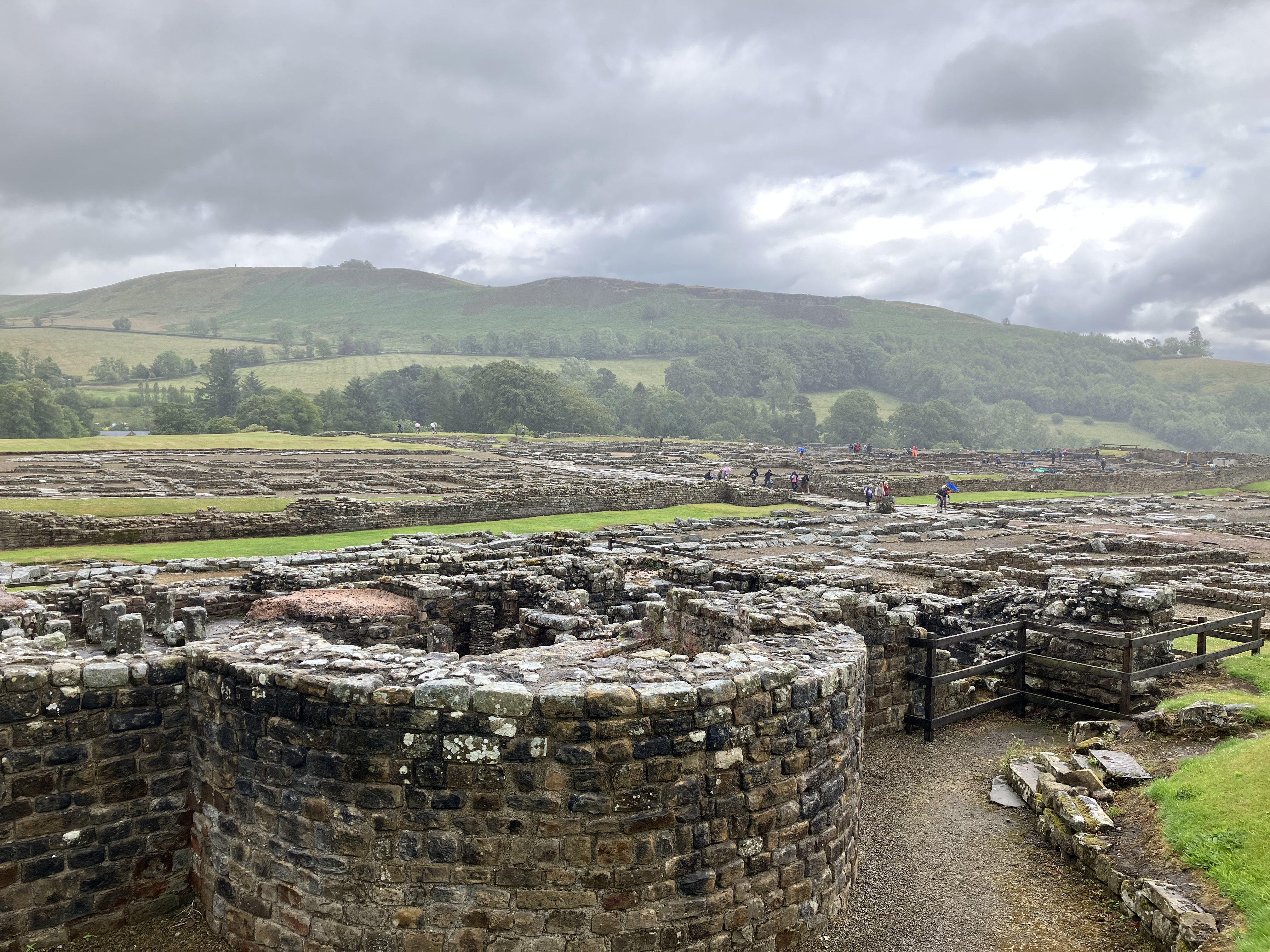
Vindolanda: destination for one of three NCS excursions and excellent reminder of the many peoples involved in the Roman colonial project.
The 2022 NCS Congress featured an inspiring number of sessions with a global or multi-cultural perspective. And a good number of presenters were from non-Anglophone backgrounds, though many were unable to attend in person because of visa, funding, and pandemic restrictions.
Because there’s still a chance for you to view the Congress sessions and uploaded presentations–here’s a quick list of the papers/sessions dealing with Chaucer’s reception, global and otherwise, that I attended.
Papers
Jacqueline Burek, “Translating Troilus: The Welsh Troelus a Chresyd“
Louise D’Arcens, “The Kangaroo Kelmscott: Chaucer’s Sydney Afterlife and Australian Deep Time”
Aistė Kiltinavičiūtė, “Reimagining the Dream Poet: Edward Burne-Jones’s Dantean Chaucer”
Usha Vishnuvajjala, “Feminist Medievalisms and Chaucer in Jane Austen Fanfiction”
Wajid Ayed, “Chaucer in Tunisia: 50 years”
Raúl Ariza-Barile “From Southwark to the Citee of Mexico: Producing the First Ever Mexican Translation of The Canterbury Tales”
Lian Zhang, “Translation as Remembering: Canterbury Tales in Chinese”
Yoshiyuki Nakao, “How to Translate Chaucer’s Multiple Subjectivities into Japanese: Ambiguities in His Speech Representation”
Amy Goodwin, “Chaucer in the New York Times”
Jonathan Hsy, “Racial Displacements: Chaucerian Poets of Color and Critical Refugee Studies”
Jamie Taylor, “Indigenous Studies and a Global Middle Ages”
Candace Barrington, “Comparative Translation: Possibilities and Limitations”
Jonathan Fruoco, “Is there an Embargo on Chaucer in France?”
Marion Turner, “The Wife of Bath’s European Lives”
Plenary Sessions
“Where Medieval Studies Joins Up,” a plenary conversation chaired by Jonathan Hsy featuring
Anthony Vahni Capildeo
Wallace Cleaves
Ananya Jahanara Kabir
The Refugee Tales, with Patience Agbabi
The Polyglot Miller’s Tale Reading
If you were a registered participant at the Congress, you can view the sessions and individual papers.
Go to ncs2020.net
Click on Attendee Hub and log in just as you did during the Congress
Select “All Sessions” on Schedule pull-down menu (upper)
Search for the speaker’s name, then follow the links to replay either the session or watch the uploaded presentation.
These links will remain available until mid-October.
In a happy reprise of the spontaneous (but very jolly) Polyglot Reading of The Miller’s Tale at the 2014 NCS Congress in Reykjavik, 14 Global Chaucerians gathered to read the tale in 9 languages (in addition to Middle English).
1.3109-3135, Middle English, Candace Barrington and Jonathan Hsy
1.3136-3166, Welsh, Jacqueline Burek
1.3167-3220, Spanish, Amanda Gerber
1.3221-3287, Lithuanian, Aistė Kiltinavičiūtė
1.3288-3338, 19c French, Juliette Vuille
1.3339-3398, German, Lucy Fleming
1.3399-3467, Arabic, Wajih Ayed
1.3468-3525, Italian, Sarah McNamer
1.3526-3588, Hebrew, Noa Nikolsky
1.3589-3656, German, Lucy Fleming
1.3657-3726, French, Jonathan Fruoco
1.3727-3785, Korean, Mariah Min
1.3786-3854, Italian, David Wallace
Some special highlights include
the premier of Jonathan Fruoco’s new French prose translation of the tale,
the first ever translation into Welsh thanks to the intrepid Jacqueline Burek,
the introduction of Korean slang and dialect into Mariah Min’s reading,
Lithuanian (need we say more?),
a sequenced chorus of Alisoun’s “Tehee” (3740), and
a recording, now streaming and available through mid-October to those who registered for the congress (either in person on online).
And, of course, lots of laughter.
In addition to thanking our fabulous readers (both new ones and repeat participants) for their full-hearted participation, we owe our deep gratitude to
Mary Flannery for initially inviting us to resume the reading at the soon-to-be postponed 2020 Congress,
Julie Orlemanski and Phil Smith for juggling schedules to ensured the reading happened in 2022,
Patience Agbabi and other members of our audience for supporting us with their presence and laughter,
Annette Kern-Stachler, Lian Zhang, Raúl Ariza-Barile kept away by the complications of pandemic-era travel, and
Durham University’s excellent tech staff who smoothly orchestrated the recording and transmission of the event.
If you were a registered participant at the Congress, you can view the streaming broadcast of the reading.
Go to ncs2020.net
Click on Attendee Hub and log in just as you did during the Congress
Select “All Sessions” on Schedule pull-down menu (upper)
Search “polyglot,” then click on “Polyglot Miller’s Tale Reading”
Click on “replay”
After lots of preliminaries, the actual reading begins at 17 minutes and ends at. 59.30
Plans are already brewing for 2024. Let us know if you’re interested in participating at globalchaucers at gmail dot com.
It’s that time again! We’re rounding up participants for the “Polyglot Miller’s Tale Reading” at the 2022 NCS Congress in Durham, UK.
After some shuffling to accommodate more participants, we’re happy to announce that the reading is now scheduled for Wednesday, 13 July, 7:30p to 8:30p.
Currently, we have volunteers to read in French, Italian, German, Polish, Arabic, Hebrew, Dutch, and (be still my heart!) Lithuanian. We’d still love to add more languages, such as Mandarin, Japanese, Korean, Hindi, Malayalam, Frisian, Romanian, Norwegian, Serbian, Icelandic, Spanish, Turkish, Afrikaans, Portuguese, Finnish, Estonian, Greek, Russian, Ewe, Farsi, Czech, Taiwainese, and any other language into which the tale has been translated. (For help finding a translation, contact us or refer to our list of translations; if you know of others, please let us know.)
Depending on the total number of volunteers, participants will be asked to read around 50-60 lines apiece.
If you’d like to be part of the fun, please email us (GlobalChaucers at gmail dot com) with this info:
which language(s) you’d like to read in;
if you possess a copy of The Miller’s Tale in that language (if you don’t, we likely can send a copy to you); and
if you consent to being recorded (both audio/video).
In mid-May, we will send your line assignments (and a copy of your lines, if requested).
We appreciate your patience as we pull together what promises to be a lively event.
Durham University is hosting the New Chaucer Society’s 2020 Congress, and there’s still time to submit paper proposals. The deadline is 20 May 2019.
Global Chaucers is organizing a lightening talk session on the Histories of Chaucer’s non-Anglophone Receptions (session 2). Jonathan and I invite your proposals exploring the histories of Chaucer’s reception beyond the Anglophone reception. Possible topics include the non-Anglophone, multilingual, or cross-cultural histories of textual transmission; translations and editions; Chaucer in the curriculum; and contributions to scholarship.
While you’re at the NCS website, take a look at Jonathan Fruoco’s session on Chaucer in the Non-Anglophone World: Translations and Cultural Appropriations (session 70).
In addition to these two sessions, many of the other sessions invite papers of global interest.
Please note the two-step process for submitting your proposal: first you register online, then you send your abstract to the session organizer(s).
Many thanks to the program organizers–Elliot Kendall, Robyn Malo, Mary Flannery, Wan-Chuan Kao, Philip Knox, Myra Seaman, Ruth Evans and Tom Goodmann –for the exciting program. The 2020 Congress in Durham promises to match the international breadth of the 2018 Congress in Toronto! Please join us!
Reception at Art Gallery of Ontario; co-sponsored by Medievalists of Color.
I began the second day of the Congress by joining a group of Global Chaucerians for breakfast at a nearby coffee shop. Jonathan and I have found informal gatherings like this are helpful for colleagues attending the NCS Congress for the first time.
For Session 3, I attended my first lightening panel: “Chaucer and Transgender Studies” moderated by Ruth Evans. The six short papers were fascinating and provocative.
Leanne MacDonald (University of Notre Dame) “Challenging Normative Notions of Transidentity in Medieval Studies”
Wan-Chuan Kao (Washington & Lee University) “Trans*domesticity”
Michelle Sauer (University of North Dakota) “Reading the ‘Glitch’: Trans-, Technology, and Gender in Medieval Texts”
Miranda Hajduk (Seton Hall University) “’My Sturdy Hardynesse’: The Wife of Bath’s Antifeminist Satire as Trans Narrative”
Cai Henderson (Centre for Medieval Studies, University of Toronto) “Christine de Pizan’s ‘droite condicion’: Authorial Construction and Resonant Reading in Transgender Text”
Because the presenters were limited to 5-7 minutes, the heart of the panel was the ensuing conversations among themselves and with the audience, as we explored transgender topics, including the ways Chaucer’s characters inhabited multiple, simultaneous identities; the transphobic elements of The Miller’s Tale; transmission glitches revealing resistance to hegemonic norms; and the nature of transgender ethics. The lightening format, a new format for NCS, proved an excellent structure for presenting ideas and generating conversation.
Plenary Roundtable: Race and Inclusion: Facing Chaucer Studies, Past and Future Evans, Barrington, Bale, Kao, Dinshaw, & Sévère
Next up, the program featured a plenary panel on Race and Inclusion: Facing Chaucer Studies, Past and Future. The five speakers were Anthony Bale (Birkbeck, University of London), Candace Barrington (Central Connecticut State University), Carolyn Dinshaw (New York University), Wan-Chuan Kao (Washington and Lee University), and Richard Sévère (Valparaiso University). The invitations to participate on the panel were issued nearly year ago, and the subsequent months proved the program committee’s wisdom in forming the plenary round-table addressing questions of race, whiteness, and inclusion in the field of Chaucer studies.
The program committee requested that our short presentations consider “more broadly the historical past of our field as well as our ethics of engagement in the present, and to look forward to what needs to happen next.” We were also asked to consider the international dimension of our society and “to offer a past-future presentation on whatever facet of Chaucer” we would like to address.
Scholarship in the field of race and Chaucer specifically, which can include Orientalism and antisemitism, etc.
Scholarship about Chaucer and medievalism as it relates to race
Strategies for pedagogy when it comes to racially inclusive classrooms, etc.
Race and mentorship in Chaucer studies
The role of NCS as public face for Chaucer studies in these contexts
Methods for decolonizing Chaucer Studies
While the five of us each approached the task differently, we all ended by focusing on our individual and institutional responsibilities to ensure that, despite our mistakes as scholars and teachers, we make the study of the literary past open to everyone. The panel generated useful conversations that should extend well beyond the limits of the Congress.
OACCT Contributor Picnic.
At lunchtime, many contributors to the Open Access Companion to the Canterbury Talesgathered for a picnic lunch on the lawn outside Victoria College. For the first time since Brantley Bryant broached the idea to a group of scholars in 2015, the large group assembled, with some of us meeting each other for the first time.
Because I am very interested in the sorts of texts we provide students and scholars throughout the world, I attended the two afternoon sessions organized by Elizabeth Scala: Is There a Text for This Class? Editing Chaucer Now I & II. There are many proposed solutions to our current predicament, and I’m eager to see if any address the needs of undergraduate students (like mine) who are eager to engage with early literatures but have no plans for graduate study.
After those two sessions, I met Ruen-Chuan Ma, an early-career medievalist at Utah Valley University. We were introduced through the NCS mentorship program organized by Tom Hahn (Rochester University), Shazia Jagot (University of Surrey), and Sierra Lomuto (Macalester College). As we talked, we walked leisurely to the Art Gallery of Ontario for a reception co-hosted by Medievalist of Color and featuring a display of art objects—Ethiopian religious paintings and European boxwood beads—accompanied by a beautiful, contextualizing pamphlet (written by Meseret Oldjira [Princeton University] and Seeta Chaganti [University of California, Davis]). Attendees were provided “thought questions,” and I’m going to close Day 2’s posting with them.
If you are a senior scholar, what can you do to help grad students and less-established scholars of color feel welcome in a field that has historically alienated people of color? (Note that NCS has a wonderful mentorship program that will serve this end really well.)
If you are a journal or book editor, what do you think about the diversity of the authors your publication or list represents? What can you do to improve that diversity?
For everyone: how can we create networks together that will be truly inclusive?